September 23, 2026
Gradient's New Expected Possession Value Model Explained
Announcements


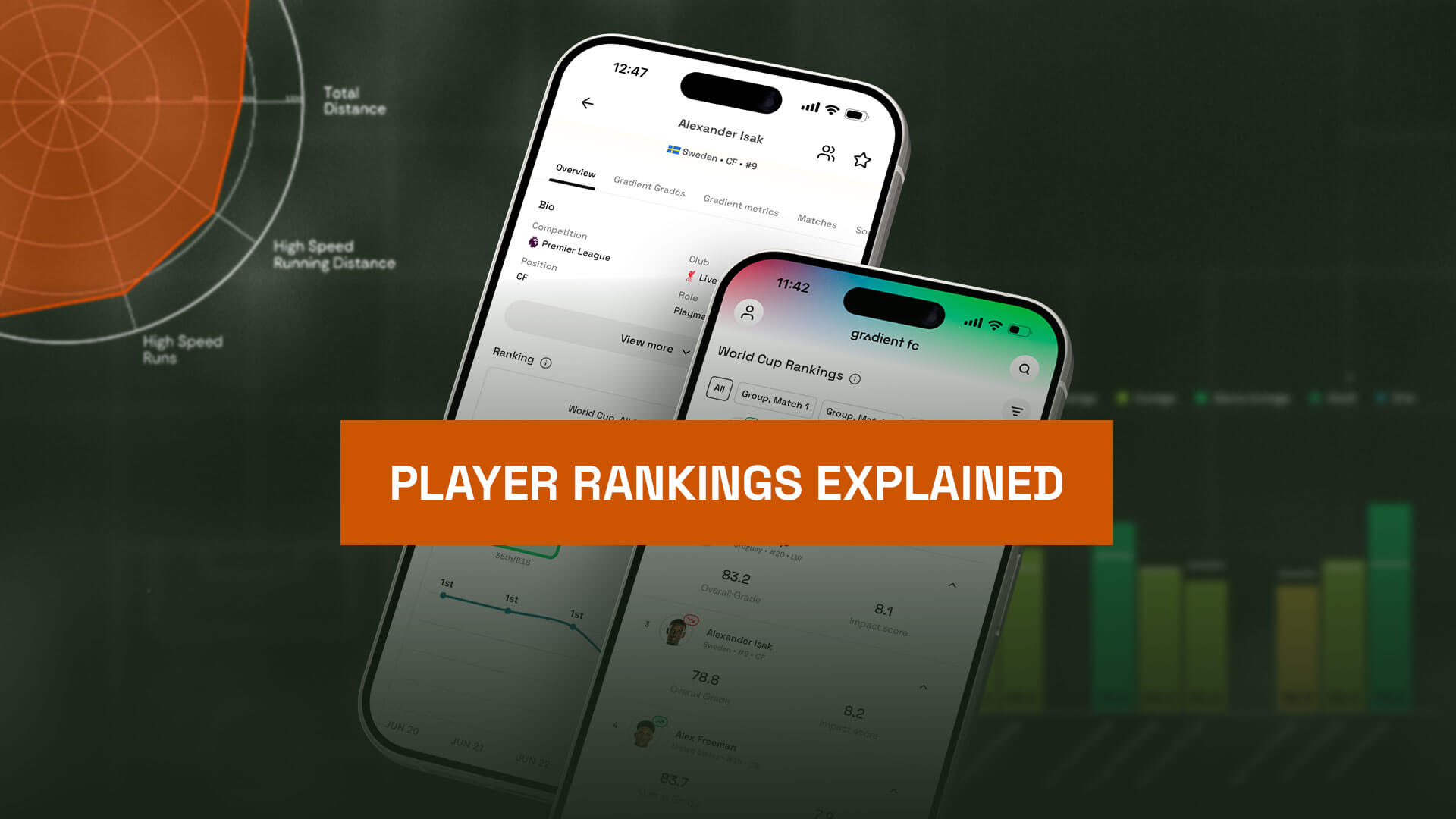
Ahead of the 2026 World Cup, Gradient Sports released the Gradient FC app to help fans of all levels better understand player performance.
Much of the app’s data and insight will feel familiar to those who follow Gradient’s blog and social channels.
Specifically, the app features Gradient’s club-trusted Player Grades, which evaluate execution quality rather than outcome alone. And those Grades are supported by Gradient’s best-in-class event data, named “metrics” in the app, which range from simple action counts to more detailed readouts like line-breaking passes, crosses into dangerous areas and shots from half-chance positions.
With 100+ Grades and metrics for every player, Gradient FC gives fans unprecedented access to pro-level data and insights, empowering a smarter generation of football fandom.
Beyond Player Grades and metrics, Gradient FC features a dynamic Player Rankings list: the first and only holistic, fan-facing player ranking on the market powered by pro-level data science.
Player Rankings differ from individual Player Grades and metrics in that they provide an all-in-one evaluation of past player performance, rather than breaking down execution quality and outcomes by specific skills and actions.
To capture and quantify total player performance, Gradient FC factors two key indicators: Overall Grade, a positionally-weighted aggregate of executionally-focused Player Grades, and Impact Score, a positionally-weighted aggregate of outcome-based metrics.
In simple terms, Overall Grade tells users how well a player executes the skills most important to their position, while Impact Score tells users how frequently a player delivers outcomes most important to their position.
For example, a tap-in goal and a 40-yard-screamer goal would receive the same Impact Score because they resulted in the same outcome: a goal. But the 40-yard golazo would receive a higher Overall Grade value because it required a higher level of skill to execute.
The same goes for a scuffed-cross assist vs. a perfectly-weighted trivela assist that is bent around three defenders: The scuffed-cross assist (low-execution quality) receives the same Impact Score value as the trivela assist (high-execution quality) but a lower Overall Grade value.
By factoring both Overall Grade and Impact Score, Gradient FC’s Player Rankings show which players are executing at a high level and delivering meaningful outcomes – something all other player ratings miss.
Note: All Grades and metrics are considered for every player, regardless of position. But positional weighting ensures shooting Grades and metrics, for example, factor more into a striker’s Overall Grade and Impact Score than they would for a center back. The opposite would be true for clearance Grades and metrics.
Player Grades were developed first and foremost as a scouting tool, and as such, excel at predictive analysis. That’s because a player who consistently executes a skill at a high level is more likely to sustain their performance than a player who executes a skill poorly but still has the outcome go their way. (See the scuffed cross example above.)
But for Gradient FC Player Rankings, which aim to summarize and quantify past performances, it’s important to balance execution quality with outcomes. A player who scores 12 tap-ins in a season may not be a top-quality shooter, but that player’s goals did positively impact their team’s performance that season.
Users can sort Player Rankings by Rank, which factors both Overall Grade and Impact Score, or by Overall Grade and Impact Score independently – enabling exploration by whichever category that user values most.
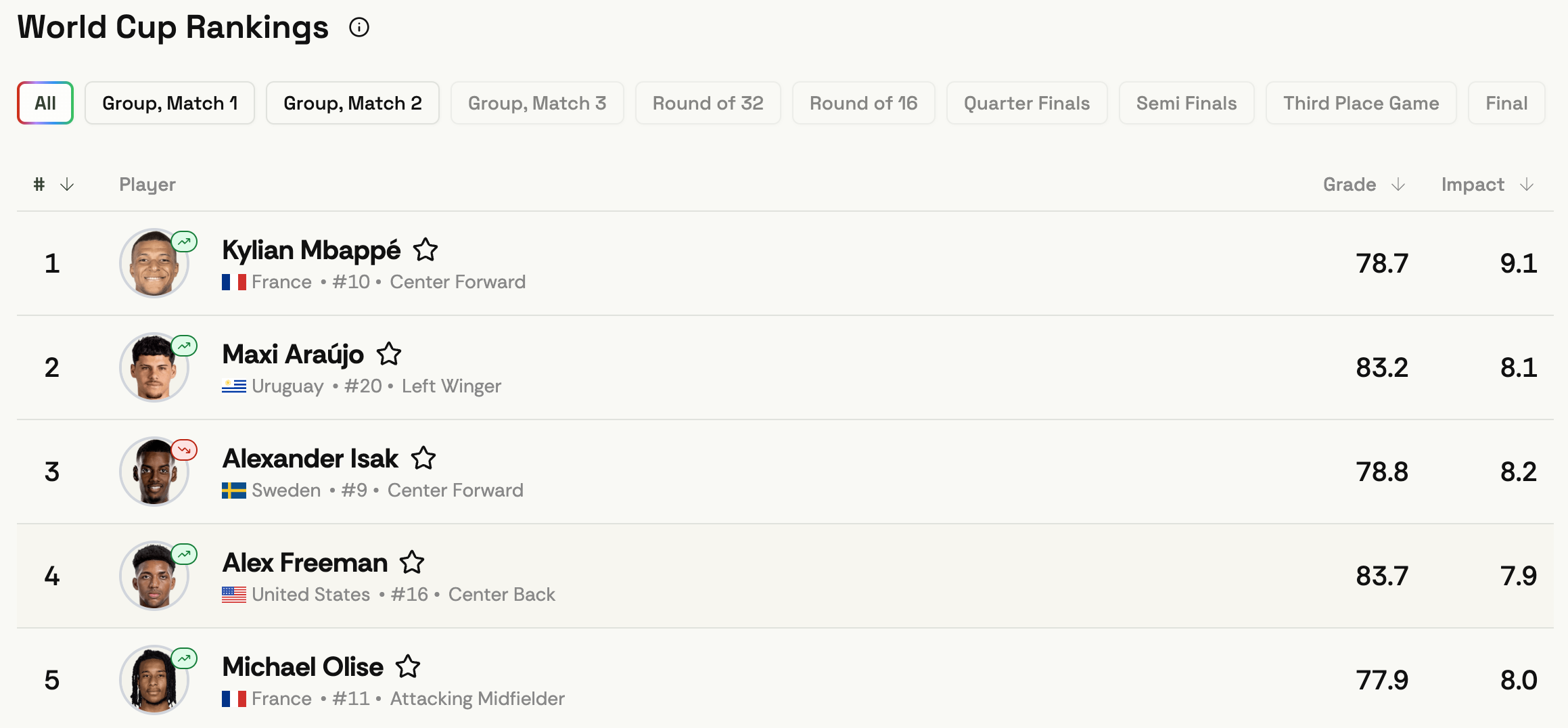
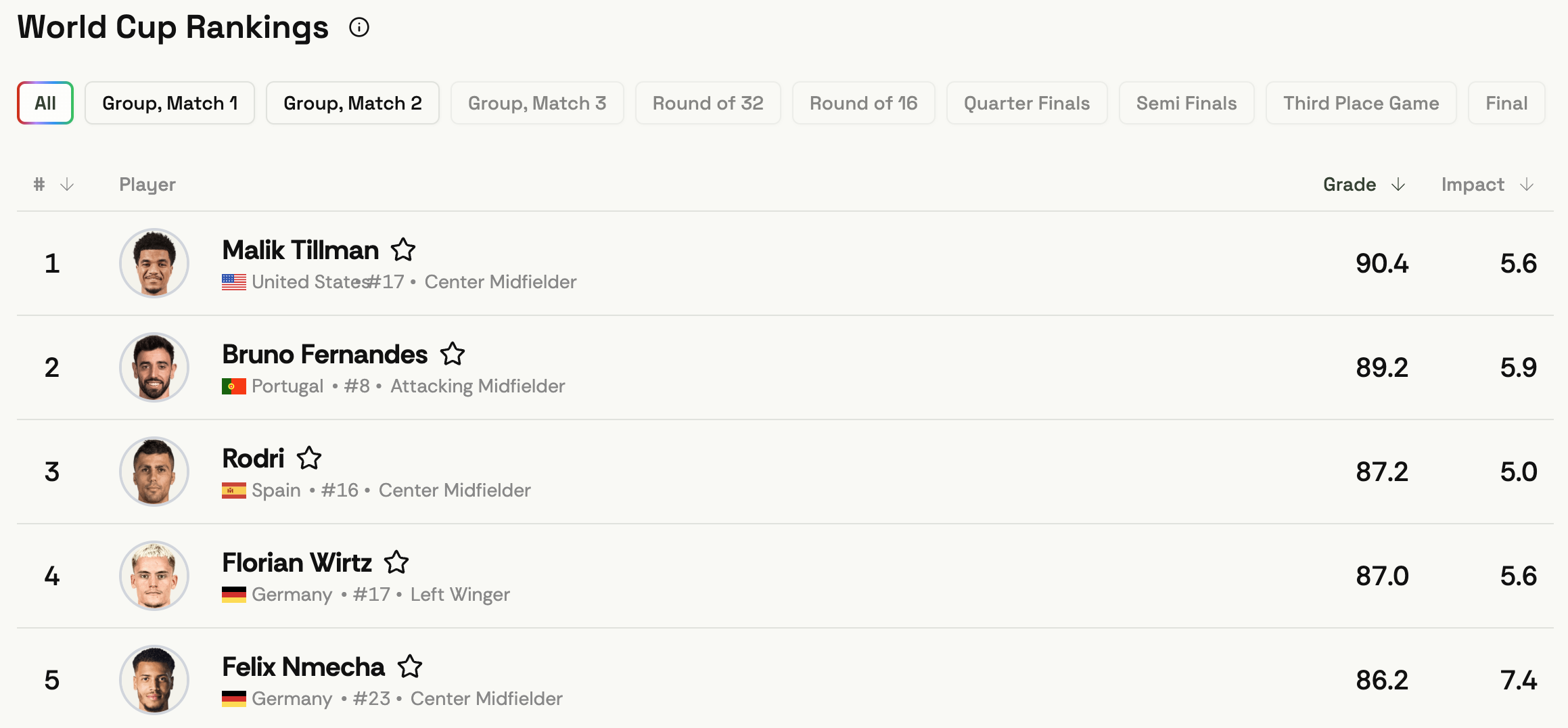

Yes and no. Neither Overall Grade nor Impact Score are inherently weighted more than the other. However, if a player is elite in one category, that category will receive more weight in order to reward the rarity of that level of performance.
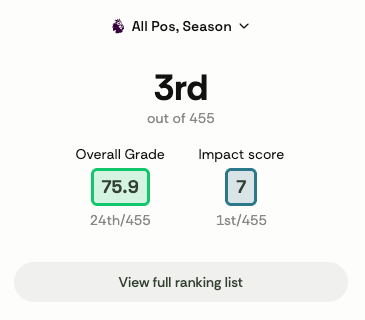
For example, Erling Haaland had the best Impact Score in the Premier League last season and the 24th-best Overall Grade. Because his impact score is truly elite, it factors more into his final Rank than his Overall Grade.
The inverse is true for Declan Rice’s Rank, which receives a boost from his best-in-Prem Overall Grade.
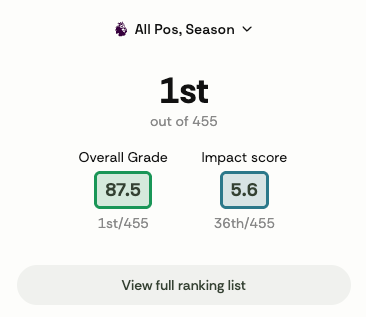
Moreover, Player Grades and Impact Scores are normalized based on all of the seasons in Gradient’s archives, ensuring what is "good" or "elite" is contextualized against as many examples as possible. In the context of all seasons covered by Gradient, Rice’s Overall Grade of 87.5 is more elite than Haaland’s Impact Score of 7.0, giving Rice another boost in Rank.
Again, yes and no.
Impact Score averages the amount of positive actions per match, so a player doesn’t need to play every match to receive a high Impact Score for the season. However, players who accumulate more total positive outcomes in a season do receive a slight boost.
Player Grades are more nuanced because they factor action thresholds and regressions to the mean. Those regressions to the mean help balance Grades for players who performed a small-sample size of certain actions, relative to the competition.
For example, a player who took one shot the entire year and scored from 40-yards-out is unlikely to be a perfect shooter, even though their one and only shot may have received a perfect Grade.
Think of it as a trust tax. The player who averages three positively-graded shots for 15 consecutive matches will be taxed less than the player who had three positively-graded shots in one match and then sat out the rest of the season with an injury.
For the Overall Grade factor in Player Rankings, the more minutes a player gets, the higher their Overall Grade will be, provided they played well in the minutes given. (Negative Grades are also regressed to the mean for small sample sizes.)
Because Player Grades from smaller samples are more heavily regressed to the mean, Gradient incorporates a different methodology for single-match Grades and full-season/tournament Grades.
Single-match Grades have less regression to the mean applied because every player has a relatively low number of events within one match. Full-season Grades have stricter regression to the mean applied, accounting for the larger pool of events over the course of an entire season.
The softer regression to the mean for single-match Grades allows one perfectly-executed, match-defining action to receive the credit its worth, while the stricter regression to the mean for full-season Grades ensures that a player’s season is not defined by one anomaly action (good or bad).
In Player Rankings, timeframe filters labeled All or Season use the full-season methodology. Filters for a specific tournament round or match use the single-match methodology.
Gradient FC’s Player Rankings are built to show a full picture of player performance. By factoring both executionally-focused Overall Grades and outcome-driven Impact Scores, Rankings reward players who perform actions well, players who produce match-changing moments, and, especially, players who do both.
Happy insight hunting!