September 23, 2026
Gradient's New Expected Possession Value Model Explained
Announcements


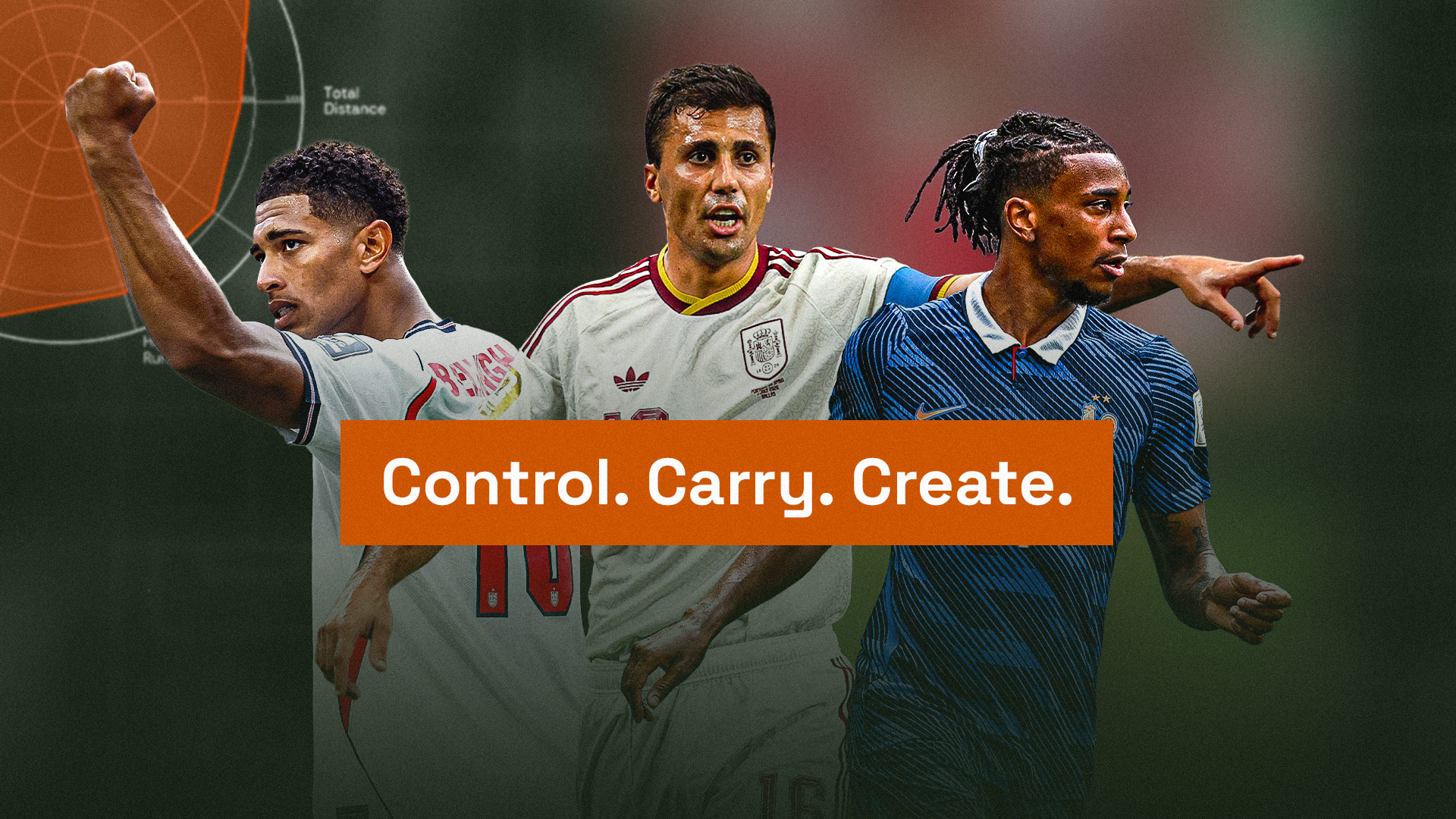
Every World Cup produces a small group of players who define how it is remembered. The headlines in 2026 belonged to the Golden Boot race, and to Lionel Messi and Kylian Mbappé trading goals at the top of it. But the tournament also belonged to midfielders, and to three in particular. Rodri sat at the base of the side that won it, controlling possession and dictating the pace of Spain's progress. Jude Bellingham drove England forward through the areas where most teams get stuck. Michael Olise created more than any player in the competition and rewrote a record that had stood since 1970. Each did the job differently, and we're using Gradient Player Grades and metrics to show how.
Spain's World Cup triumph was ultimately built on control. They dictated possession, restricted opponents to remarkably low levels of chance creation, and consistently looked the tournament's most complete side, conceding just 2.31 expected goals across seven matches — the least in World Cup history.
Rodri was essential to this control, operating as the central progressive hub at the base of Spain's midfield. The Golden Ball winner connected every phase of possession while providing the defensive security that allowed those around him to play and press with freedom.
Months before the tournament, Pep Guardiola predicted that Rodri's return to his very best would arrive not during Manchester City's season, but at the World Cup. As per usual, he was exactly right.
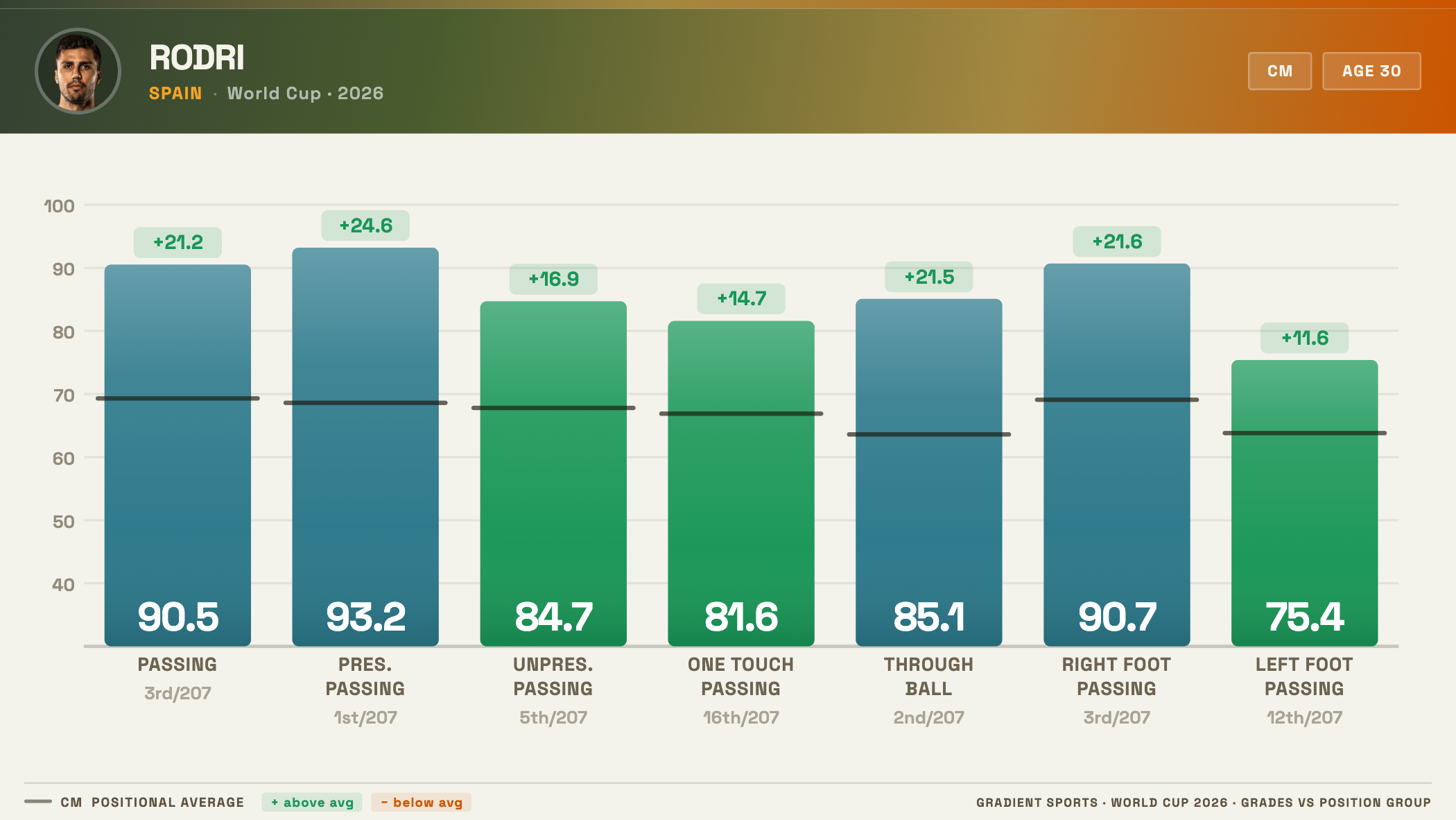
Spain's tactical approach under Luis de la Fuente is rooted in many of the positional principles that define the country's footballing identity. In possession, they settle into a quintessentially Spanish 4-3-3 structure, built around creating numerical superiority through constant rotations, short passing combinations and interconnected triangles deliberately constructed throughout the pitch — from the build-up structure formed by Rodri and the two centre-backs, to the wide relationships between the midfielders, wingers and advancing full-backs. Players rotate instinctively within these structures — having played this way together their whole life — continually creating new passing angles which pull pressing schemes out of shape. Opposing teams are worn down physically and mentally through one-touch football, with Rodri's 28.8 one touch possessions per 90 ranked 2nd among all players at the tournament.
Spain used sustained circulation to manipulate rest defenses, patiently drawing opponents towards the ball before progressing through the vacated spaces. Rodri and Spain’s elite ball-playing centre-backs repeatedly invited pressure before breaking lines into the half-spaces, allowing others to receive on the turn or quickly release play into wide areas. Once there, the rotations continue. Underlapping and overlapping runs from Marc Cucurella and Pedro Porro regularly created numerical overloads against isolated defenders, stretching defensive lines horizontally before exploiting the spaces that inevitably appeared.
No player is more fundamental to this process than Rodri, carrying on the lineage of legendary Spanish holding midfielders as the heir to Sergio Busquets and Xabi Alonso. He is the reference point around which Spain's entire structure revolves, facilitating the movement of the ball between players ahead of him while using his expansive passing range to stretch the opposition back line.
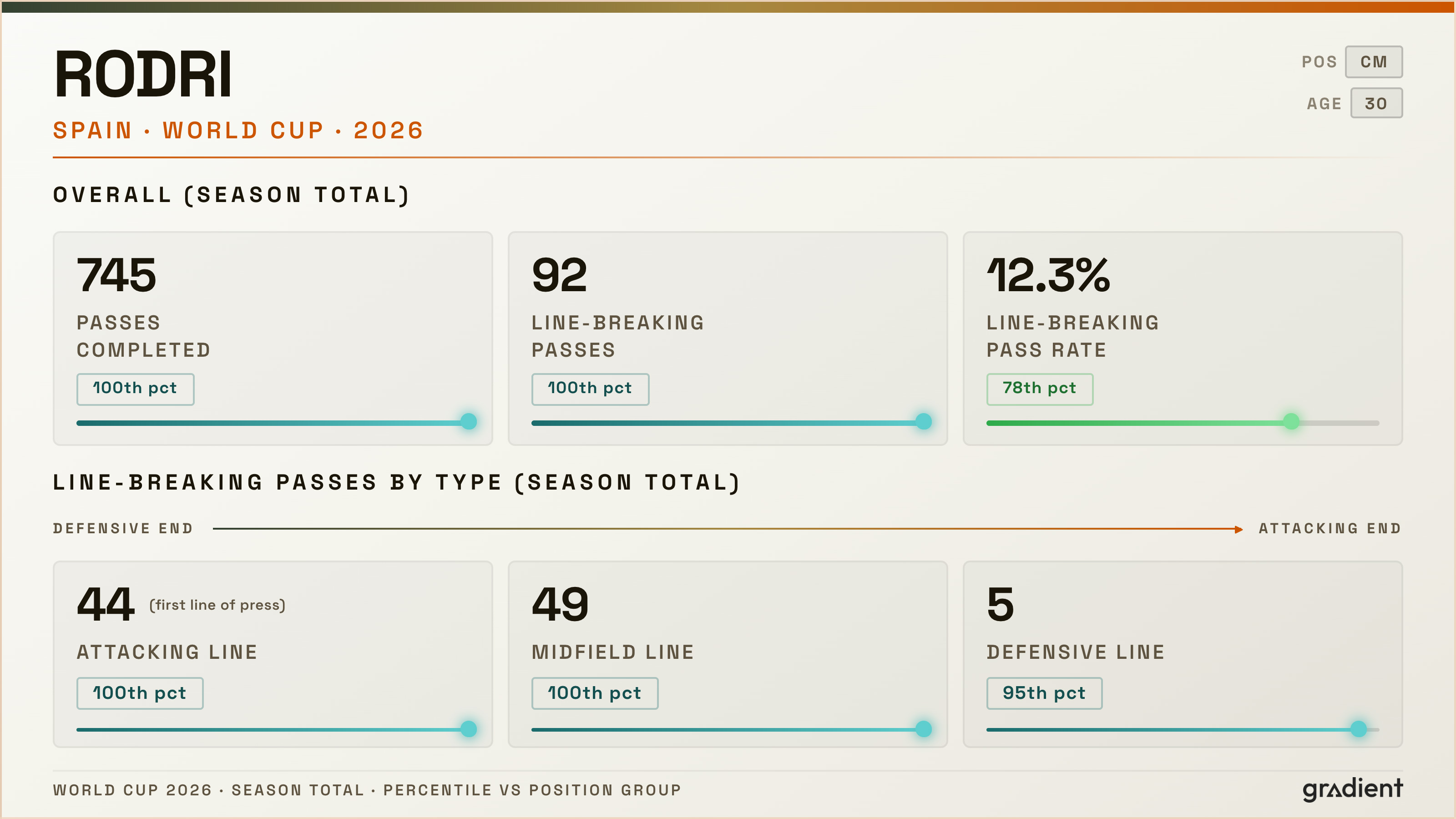
That tactical responsibility is clear in Gradient's data. Rodri had 846 possessions of the ball, more than any other player at the World Cup, illustrating just how frequently Spain's attacks flowed through their pivot. He also completed a tournament-high 92 line-breaking passes at a dependable 93.9% completion rate — 34 more than 1st place at the 2022 World Cup (John Stones, 58).
Rodri attempted 508 passes under pressure — again the highest total of any player — and successfully completed 472. He also recorded a tournament-leading 710 accurately graded passes, while his 200 forward passes ranked first among midfielders and behind only teammates Pau Cubarsí and Aymeric Laporte overall.
Despite carrying arguably the heaviest distribution workload of any player in the competition, his execution was consistently elite. Rodri earned a 90.5 Passing Grade (6th among midfielders), including tournament-bests in Pressured Passing Grade (93.2) and Over-the-Top Passing Grade (94.9).
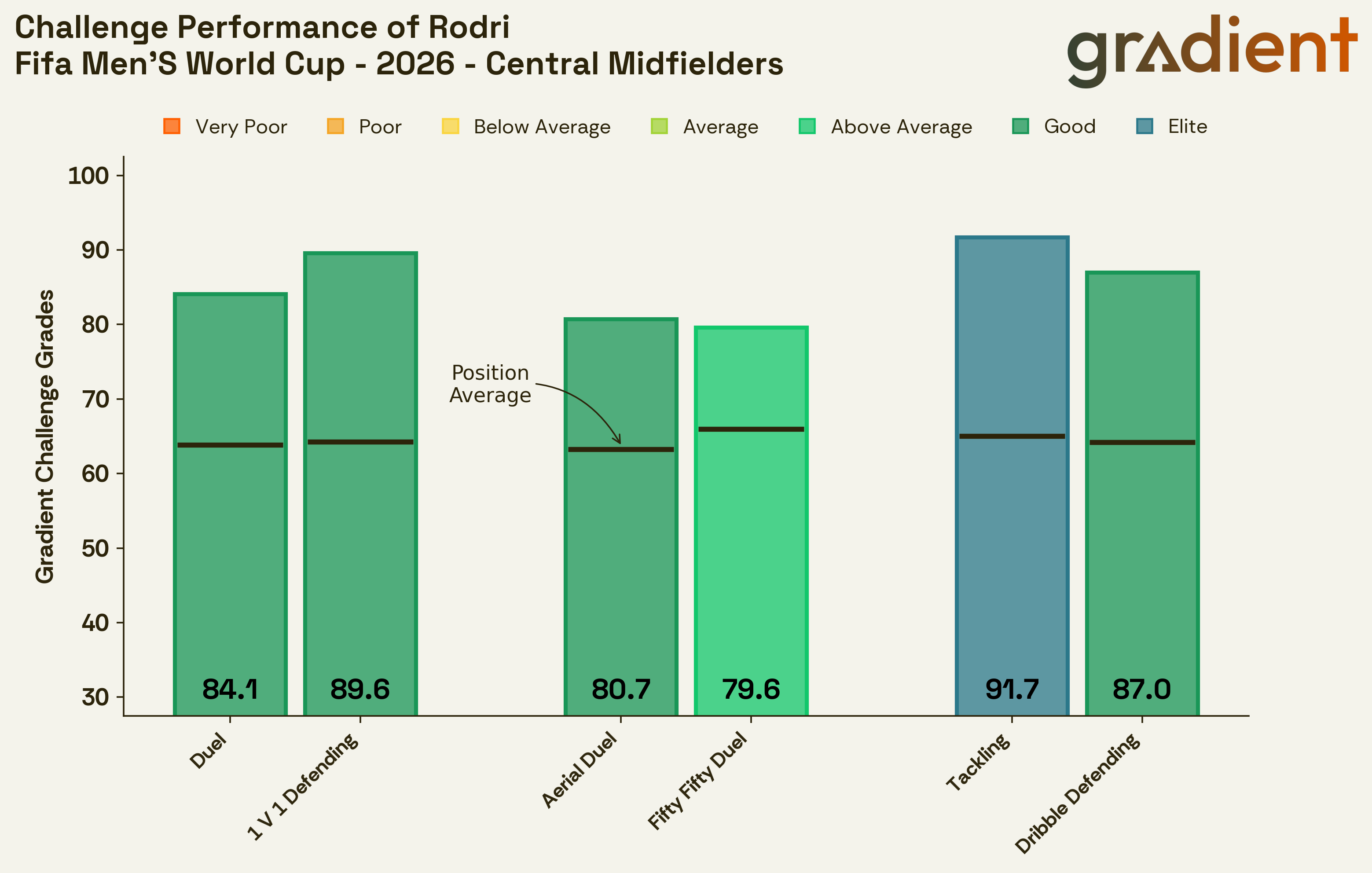
Rodri is equally impressive out of possession. He patrols the spaces in front of the back line, disrupting transitions before they develop while rarely fouling in the process, committing just 11 fouls from 93 challenge attempts. Rodri finished 2nd among midfielders for Tackling Grade (91.7), interceptions (36) and aerial duels won (19) — grading above positional average in many facets. His aerial dominance, anticipation and athletic coverage allow Spain to counter-press aggressively without sacrificing their defensive stability when teams play directly over the initial press.
In many respects, Rodri represents the complete modern holding midfielder. He combines the technical security of Busquets with the expansive distribution of Alonso, adding the physical profile required to dominate the transition-heavy nature of the modern game.
What makes his World Cup all the more remarkable is that it never felt extraordinary for Rodri himself — it simply represented a return to the level he had consistently maintained before his ACL injury. Now a World Cup winner and Golden Ball recipient, he has further entrenched his place among the defining midfielders of his generation.
Another midfielder who excelled in Gradient's grading methodology throughout the tournament was Jude Bellingham. Still only 23, Bellingham has become the focal point of England's attack, combining athleticism, ball-carrying and box-crashing instinct to establish himself as arguably the country's most important player. His qualities also made him the ideal player to execute Thomas Tuchel's tactical vision.
“In the middle area of the pitch, those 24 metres, we really feel that the game has become stuck. Particularly in the Premier League, everybody is so good now, they have so much information, they know how to set up. We are really trying to focus on accelerating the game across that 24 metres,” England assistant coach Anthony Barry explained. “We noticed that if we dominated the edge of the penalty area, then all of the acceleration would come.”
That principle shaped Thomas Tuchel's England. Rather than prioritising prolonged spells of controlled possession, England sought to progress quickly through the thirds, avoiding unnecessary circulation through the congested central zone Barry described. Instead, they regularly advanced play through wide rotations and combinations or by finding runners beyond the ball before defensive structures could recover. England's athleticism and physicality facilitated their approach, allowing them to maintain high attacking intensity while aggressively counter-pressing and winning the duels that prevented opponents from settling into shape.
Bellingham's ability to eliminate defenders in possession made him ideal for this system. He recorded a 90.5 Dribbling Grade — the highest among midfielders and sixth overall — alongside an 89.2 Tackle Resistance Grade, ranking third among midfielders and sixth overall. Against Mexico, players attempted to tackle Bellingham 16 times and succeeded only once. Those qualities allowed him to carry England through pressure quickly and consistently break opposition lines.
They also made him an ideal foil to Harry Kane. As Kane dropped into deeper areas to facilitate play with his outstanding passing range and distribution, Bellingham consistently attacked the spaces left ahead of him. The pair operated in a push-pull dynamic: Kane drew defenders towards the ball before Bellingham surged beyond them, either carrying possession himself or exploiting the space Kane had created.
Bellingham’s off-ball movement was among the best in the tournament. He ranked in the 100th percentile for advance runs, while also placing in the 96th percentile for support runs and the 91st percentile for forward runs among attacking midfielders.
.png)
His willing movement translated into exceptional goalscoring output. Bellingham's 94.4 Shooting Grade ranked first among all players at the tournament, scoring seven goals from just 20 shot attempts, with 68% of his efforts hitting the target. Five of those shots were graded as unsavable by our analysts. Perhaps most remarkably, his tournament shooting stat line — seven goals from 20 shot attempts, including five unsavable efforts — was near identical to Erling Haaland's. The difference, of course, is that Haaland produced those numbers as one of football's elite poachers, while Bellingham did so from midfield.
.png)
Taken together, those qualities made Bellingham one of the tournament's defining performers. He earned an 89.4 On-Ball Attacking Grade — the highest of any player, ahead of Lionel Messi (87.5) in second, and Lee Kang-in (86.7) in third — while his 94.6 Overall Grade ranked fourth at the World Cup. With Bellingham soon entering his prime years, England possess a genuine talisman. Building a system that continues to maximise his unique combination of athleticism, ball-carrying and box-crashing instinct should be England’s priority. Most importantly, he has a knack for rising to the occasion — he’s just one of 3 players to rank inside the top 10 of our Overall Grade for both the 2022 and 2026 World Cups, alongside Lionel Messi and Harry Kane.
Michael Olise entered the 2026 World Cup following a remarkable domestic season with Bayern Munich. His 93.6 Overall Grade ranked first among every midfield player evaluated across Europe's top five leagues during the 2025/26 season. He translated that form seamlessly onto the international stage, leading the tournament with seven assists — the most ever in a World Cup campaign, surpassing Pelé’s record.
During France’s opening two matches, Olise operated predominantly from the right wing but regularly dropped deeper within the right half-space to receive and create. Those movements drew defenders away from the back line, opening passing lanes for him to exploit.
His assist for Mbappé against Senegal perfectly illustrated those qualities. Receiving in the right half-space, Olise split three defenders with an impeccably weighted pass. Five of his eight assists were finished by Mbappé, underlining how productive their partnership became.
France's tactical adjustment after the opening two matches only amplified his influence. Moving Olise into the number ten role behind Mbappé gave him direct access to both half-spaces and a greater variety of passing angles. There, he repeatedly accepted possession in heavily congested spaces between the lines, using his exceptional ball retention and rapid turns to evade pressure before immediately releasing runners. His movement also made him one of France's primary progression outlets, receiving 58 line-breaking passes throughout the tournament as teammates consistently trusted him to receive under pressure as a connector. It also created additional space for Mbappé to attack from the left channel, while Dembélé stretched the pitch from the right as a genuine two-footed scoring threat. The adjustment proved successful, with Olise producing five further assists after moving centrally.
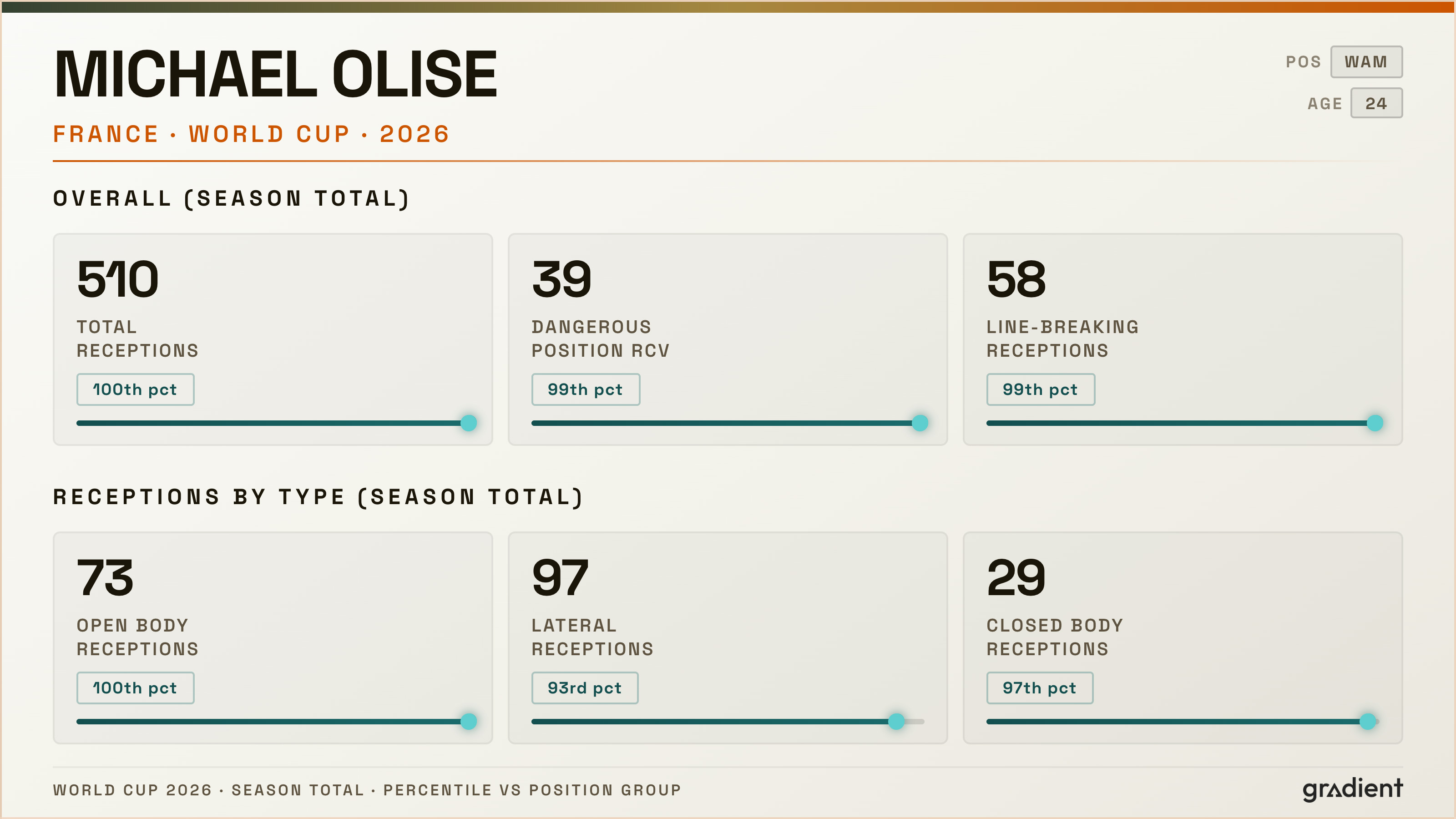
He recorded a 95.2 Passing Grade, the second-highest of any player, alongside a 99.0 Through Ball Passing Grade — the highest recorded at the tournament. The gap to second place was considerable, with Leandro Trossard next on 88.6.
Olise completed a tournament-high 20 accurate through balls, created 20 chances (3rd) and delivered 45 passes into dangerous positions (2nd). His 27 positively graded passes also ranked third overall, behind only Lionel Messi and Elliot Anderson, reflecting not only the volume of his involvement but the consistent quality of the decisions and execution behind it.
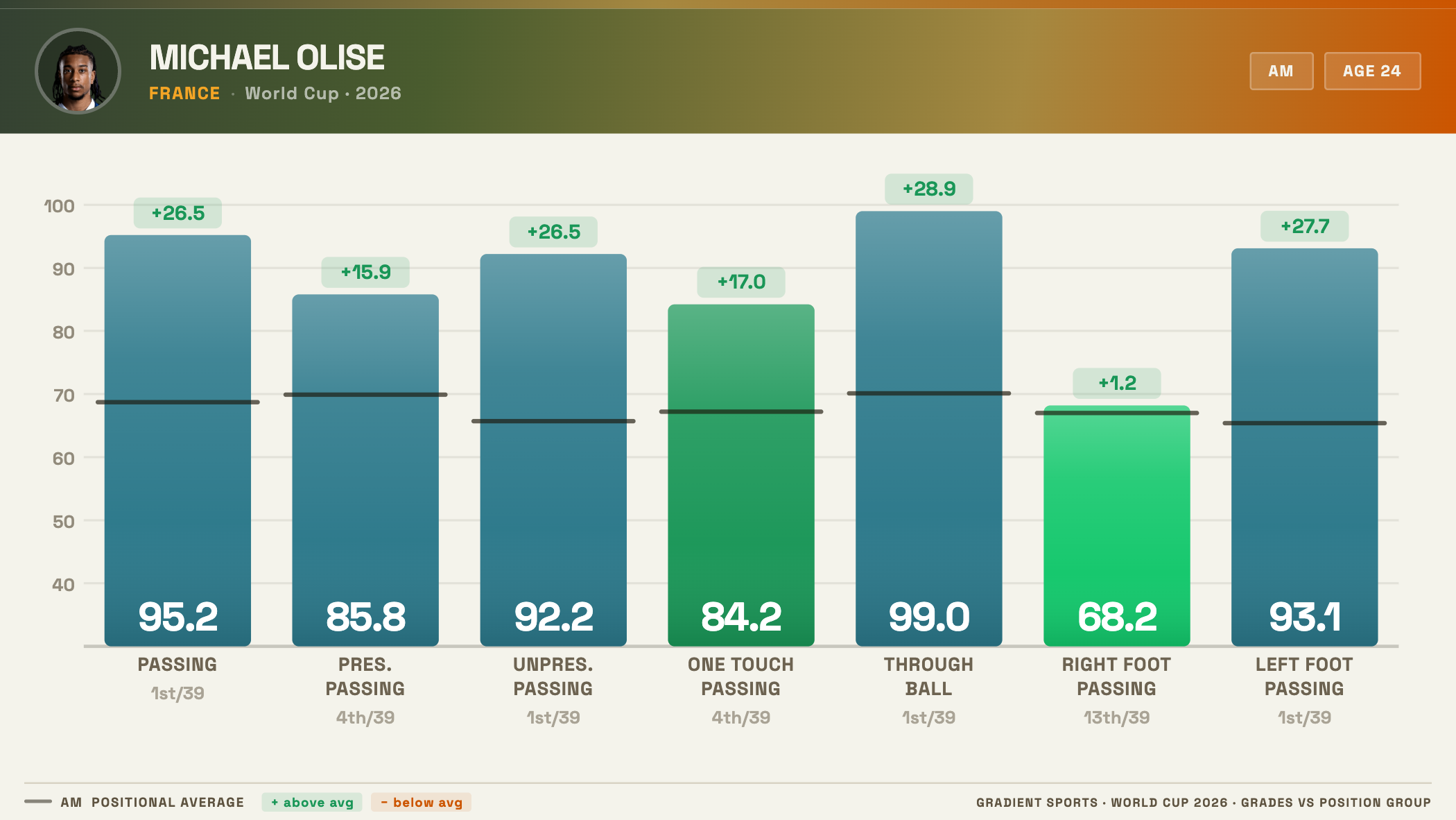
Although France ultimately fell short, Olise's creativity, technical execution and tactical intelligence transformed their attack throughout the competition. Having entered the tournament as Gradient's highest-rated midfielder — and third overall across Europe's top five leagues — he leaves it having reinforced that status, emerging as perhaps the World Cup's defining creative player.