September 23, 2026
Gradient's New Expected Possession Value Model Explained
Announcements



If you evaluate player performance by outcome-based metrics alone, you only ever see half the picture. Such metrics, think of pass accuracy, dribble success and duels won, only tell you what happened. They don't tell you how well it was done.
A defender can win an aerial duel with a commanding leap and a clean header away from danger, or by scrambling a clearance under pressure that loops straight back to the opposition. Both show up in the data the same way: one aerial duel, one win.
That's the gap Gradient Player Grades are built to close. Grades evaluate the level of execution behind each action, not just the binary result. And once you have that layer, players you thought you understood can look different.
Take centre backs in the top five European leagues. Plot their aerial duel win percentage against their Aerial Duel Grade and a clear pattern shows up: there's a real correlation, as you'd expect. But the interesting players are the ones that sit off trend.
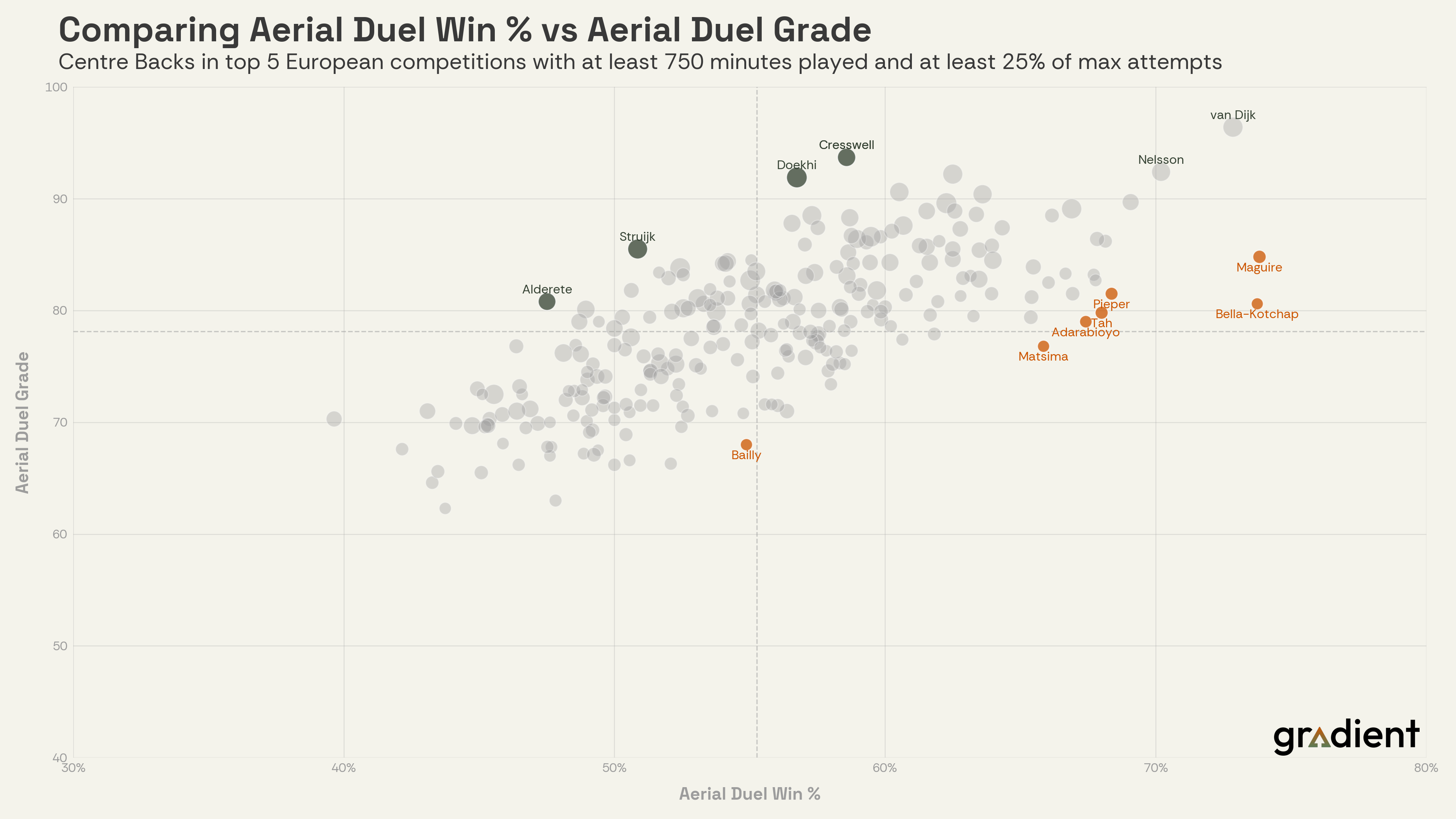
Harry Maguire (Manchester United) and Armel Bella-Kotchap (Hellas Verona) both post higher aerial win percentages than Virgil van Dijk (Liverpool), which by that metric alone would put them ahead as the best players in the air. But aerial win percentage doesn't capture the full picture, and that's where the grades add context. Van Dijk's execution in the air is in a class of its own, comfortably ahead of both. Pascal Struijk (Leeds) and Omar Alderete (Sunderland) tell a similar story from the other side: below average win percentages, yet grades in the 80s, considered very good. High win percentage and high execution have a close correlation, but aren't always the same thing.
So what is the grade actually seeing? Few aerial duels start on a true level playing field: angle and momentum tilt them. A defender meeting the ball going forward usually holds an edge over an attacker who is backpedalling. The quality of the win matters too. A clear favourite who wins cleanly will usually grade neutrally (0 raw grade), because that result was expected, unless it was the player's own physicality that built the advantage (positive grade). A slight favourite who wins cleanly earns a positive raw grade; the same player heading it loose rather than clearing it away from danger likely earns nothing (0 raw grade). And a win built on a clear foul the referee missed stays a win, but will rarely be positively graded (and most likely a downgrade if a clear foul).
Van Dijk illustrates this well. When he wins aerial duels, he tends to do so decisively, clearing the ball away from danger or creating an attacking threat in the opposition box. And when he loses one, it is mostly in a competitive fashion, rarely conceding a clear chance.
The same pattern holds for wingers and their dribbling. Dribble completion percentage and Dribbling Grade move together: players who beat their man more often tend to earn higher grades.
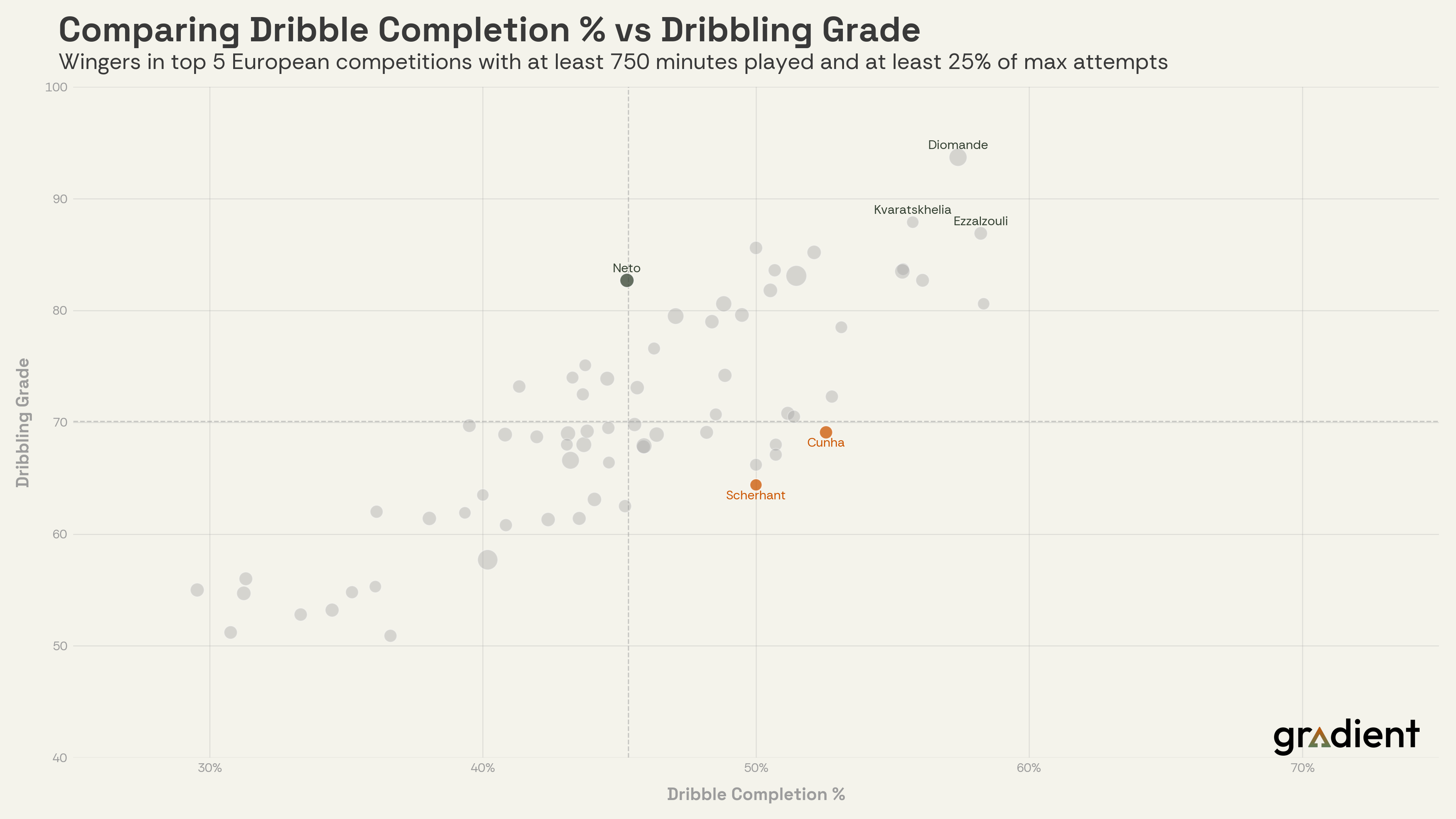
But shortlists built on completion percentage alone will mislead. Take Pedro Neto (Chelsea) and Derry Scherhant (Freiburg). Scherhant's completion rate is the higher of the two, which in isolation puts him ahead. The grades flip it: Neto sits among the most accomplished dribblers in the sample, Scherhant well below average. Same skill, opposite verdict.
With dribbling, a win and a positive grade line up more often than they do for aerial duels. Beat your man and you've usually done something right, but there are notable exceptions. A dribbler fouled on a move the referee waves on can still earn a positive grade in our system, with a missed infringement logged on top. Equally, an attacker could leave the ball exposed where the defender should win it, the defender gets a clean touch and it rebounds into space. That technically results in a dribble won, but in our system it will likely result in a 0 or even a negative downgrade. It's the execution that is graded, not the outcome.
None of this means outcome-based metrics should be discarded. Player Grades sit alongside them as an additional layer, and it's the gap between the two that tends to be most useful. Players whose outcomes exceed their grades are over-performing their execution. Players whose grades outpace their outcomes are executing well without yet being rewarded for it. It's that deeper comparison of outcome against execution that turns numbers into a scouting tool.