September 16, 2026
How do Gradient Sports Collect Line-Breaking Passes?
Enhanced Event Data


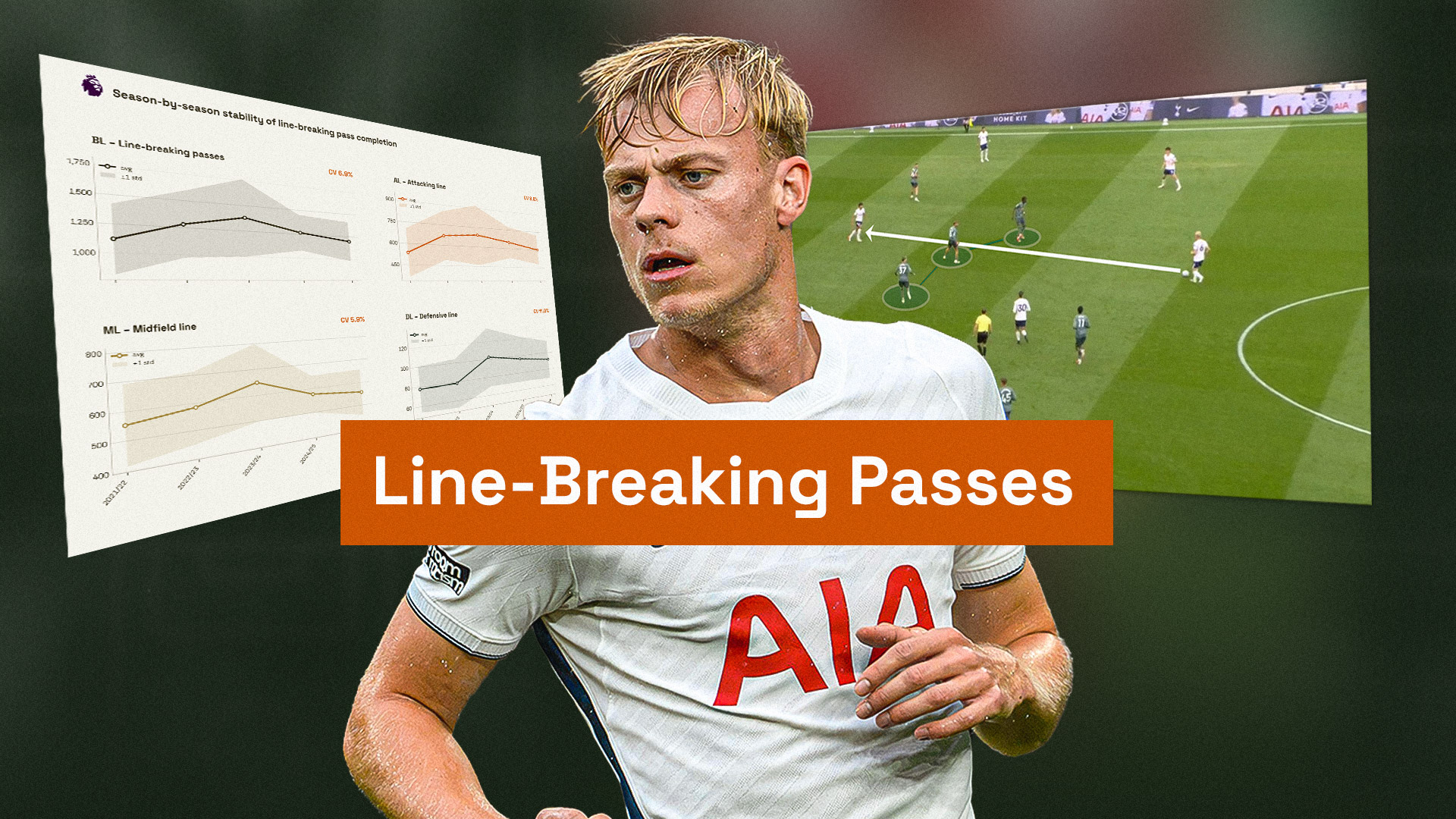
Line-breaking passes are a useful metric to help understand how a player and a team progress the ball, and whilst the term has made its way into the mainstream as an 'industry standard' metric, there is plenty of confusion as to how this is collected and defined among different providers. Whilst we cannot talk on behalf of other providers, we can showcase how our line-breaking data is collected and highlight the decisions made to make it as accurate as possible.
To break a line, the ball must pass between two opposition members of the same line at shoulder height or below, and the pass must advance the ball. We do not record line breaks for passes played backwards. In other words, a line break is not recorded if the ball passes outside of the line, goes over the line, or breaks the line moving backwards.
.gif)
Why do passes 'around the line' not count?
At Gradient Sports, we take pride in the fact that our data & grades have been developed by football professionals, with our staff combining for over 30 years of experience within a club setting. This experience shapes how we collect & grade everything, including line-breaking passes. Clubs view line-breaking passes as a metric that disrupts a team's defensive structure. Most defensive strategies are designed to encourage teams to pass around that defensive structure; therefore, passes that bypass a line on the outside often don't disrupt the defensive structure as much as passes that penetrate inside. For that reason, we exclude those passes from our line-breaking metrics.
Why do passes above shoulder height not count?
Again, this decision was made based on the experience of our staff, who have previously worked at club level professionally. This is a little more contentious than the previous question, as when developing these metrics, we were split on whether or not lofted passes should be included. Some passes, for example, that are clipped over a line into a receiver inside the opponent's defensive structure, do achieve the same thing as a more traditional line-breaking pass. However, other passes, such as long goal kicks, which result in contested possession, were unanimously not considered to be line-breaking, despite bypassing one or more lines & being received within the opponent's defensive structure. As a result, we took the decision that any passes played over a defensive line above shoulder height would be categorised differently. Instead, we collect 'create contest' passes and 'balls over the top' as the alternative data points.
Do you collect line-breaking attempts or line-breaking completions?
We collect both, as well as line-breaking pass rate (%). As our line-breaking data is manually collected, rather than modelled or automated through broadcast tracking data, we are able to capture all attempts to break a line. The manual collection is key here, as an analyst is better able to evaluate the passer's intent than more automatic processes are. For example, a passer might be attempting to play a through ball that will break both the midfield & defensive line. That pass may be intercepted by the midfield line: an automated process may be able to deduce that the midfield line was the line intended to be broken, but it is unlikely to accurately capture that a second line was also intended to be broken.
What makes Gradient's line-breaking data accurate?
As mentioned before, the most important thing to note is that our line-breaking data is manually collected. This manual process empowers our team of analysts to tag much more than just the pass itself. Because we track both attempts and completions, we can record exactly which phase of the pitch was bypassed, categorising passes that break the attacking line, midfield line, defensive line, or even multiple lines in a single action. Beyond the passer, this granular approach allows us to capture the receiving end of the event (line-breaking passes received by zone), as well as specific defensive interventions like blocked line-breaking passes and line-breaking pass interceptions. Furthermore, we apply this same methodology to other phases of play, logging line-breaking ball carries and dribbles to provide a complete view of how a team progresses the ball.
How stable is the metric?
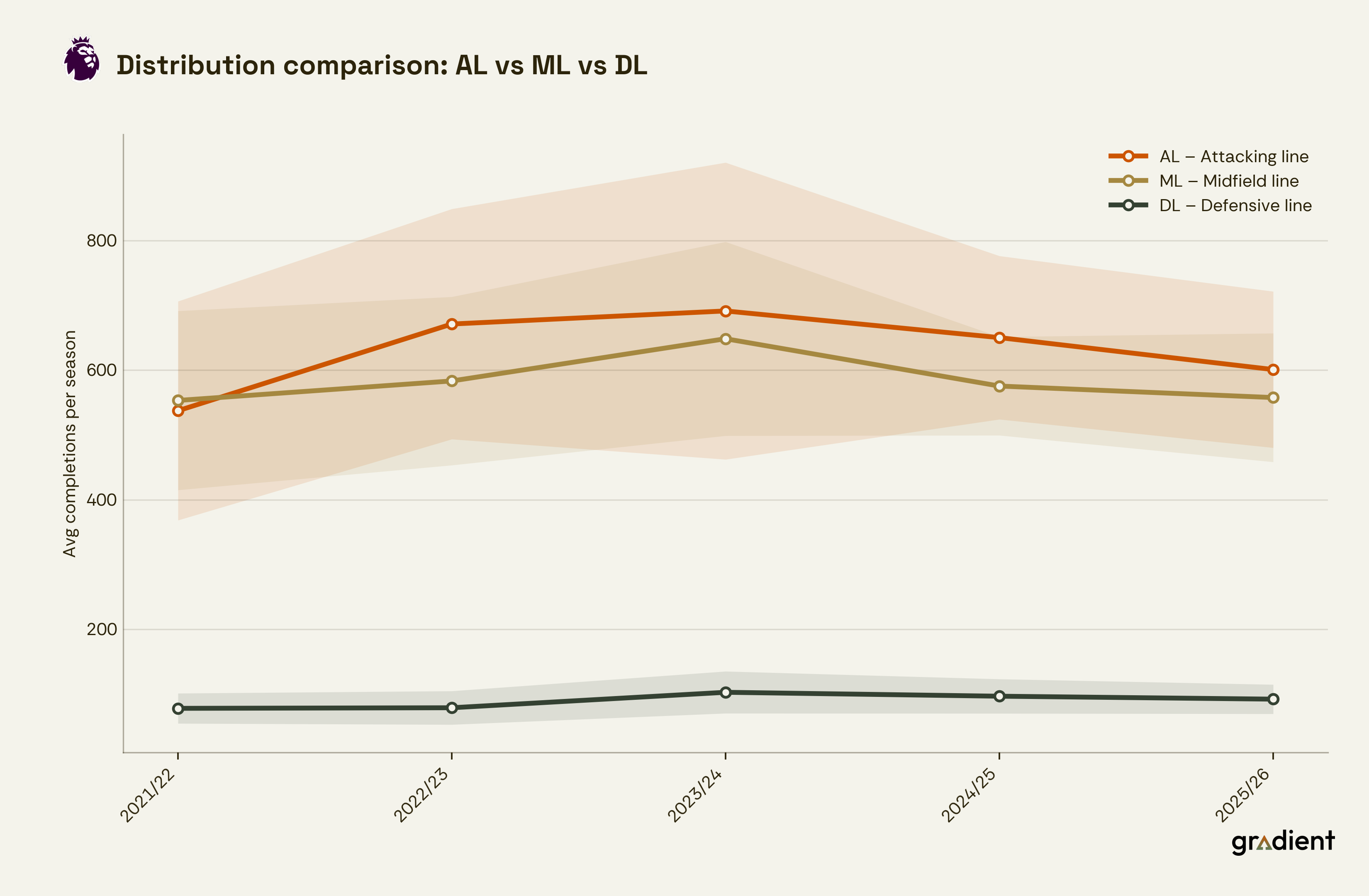
Attacking-line and midfield-line breaks track closely across the last five seasons, while defensive-line breaks sit well below both.
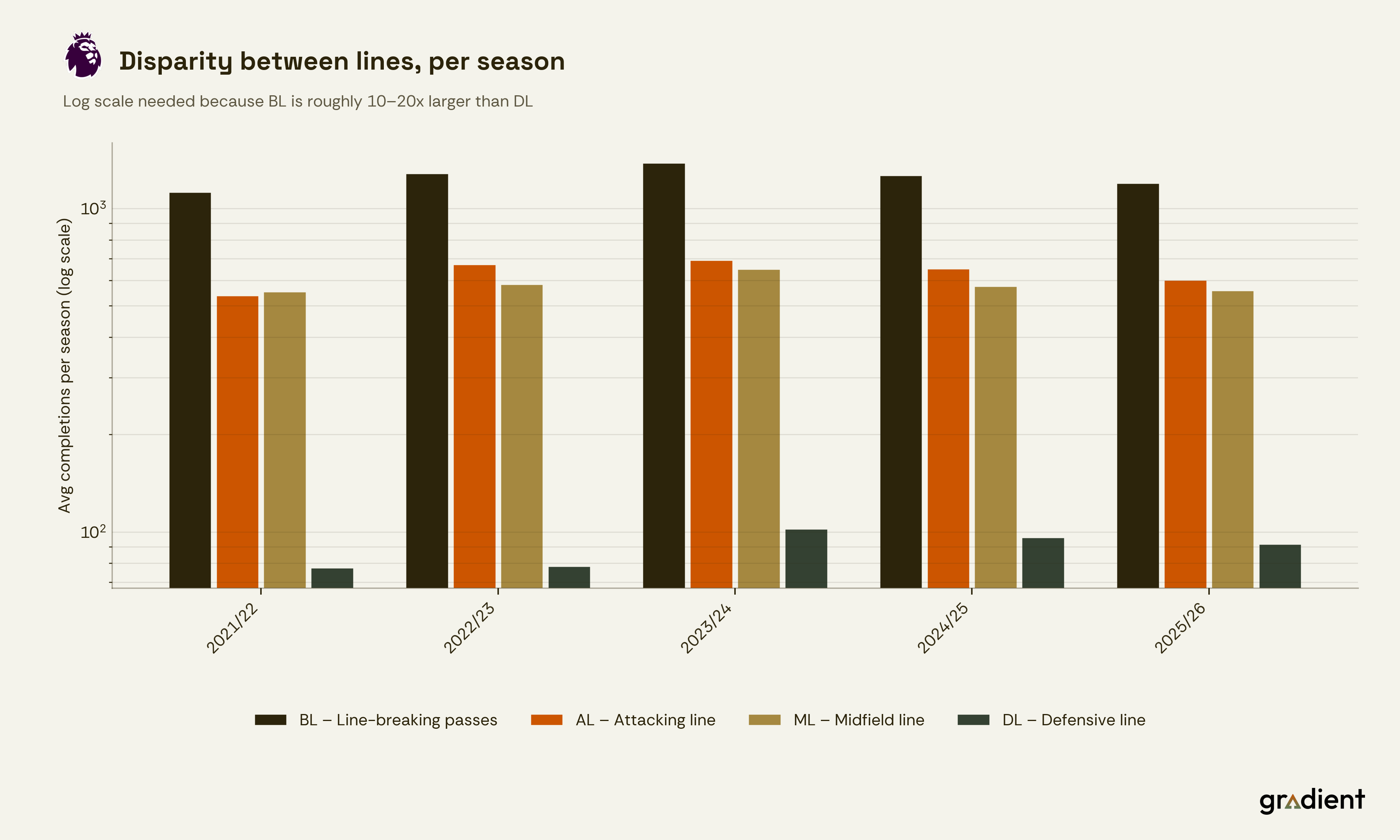
A log scale is needed because total line-breaking passes run 10 to 20 times higher than defensive-line breaks alone.
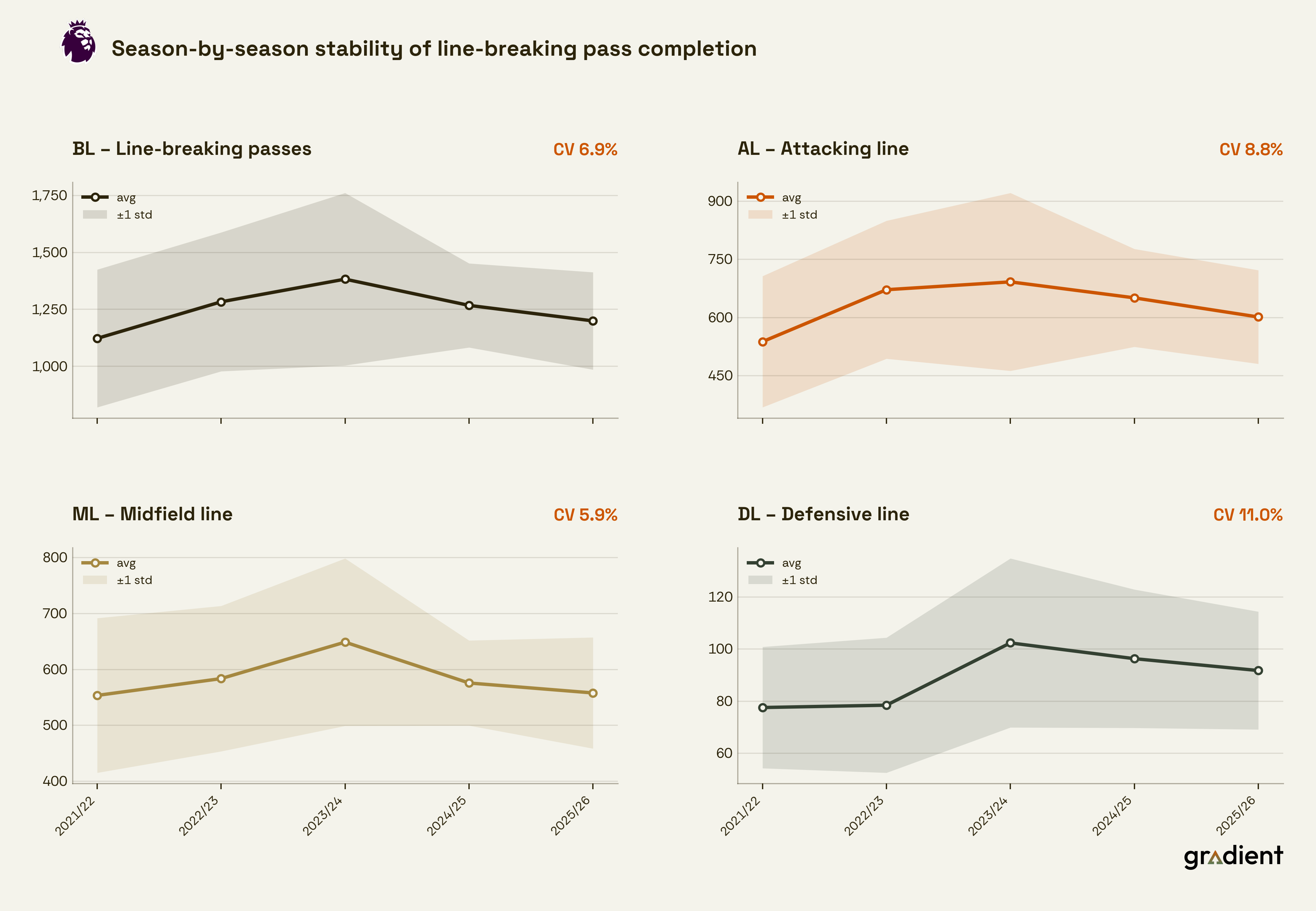
Every category has a coefficient of variation at or below 11%, showing the metric moves consistently season to season.
Stability matters here for two reasons: it validates our collection process, and it gives clients confidence that season-on-season shifts reflect genuine tactical change rather than noise in the data. Looking at raw volumes, attacking-line and midfield-line breaks sit in a similar range across the last five seasons, while defensive-line breaks are consistently far lower, roughly 7 to 8 times smaller, which is why a log scale is needed to compare all four categories on the same chart. Despite that gap in scale, each category follows a similar shape: completions rise from 2021/22 through to a peak in 2023/24, then settle back slightly across the following two seasons. More tellingly, when we measure season-to-season variability using the coefficient of variation, every line sits at or below 11% (BL: 6.9%, ML: 5.9%, AL: 8.8%, DL: 11.0%), showing that the metric moves consistently year on year rather than fluctuating erratically. That consistency is what gives us confidence that line-breaking data can be reliably used for trend analysis and player and team benchmarking over time.
Finally, we had a look at which players in the Premier League completed the most passes breaking the defensive line in the Premier League last season (2025/26).