September 16, 2026
How do Gradient Sports Collect Line-Breaking Passes?
Enhanced Event Data



The opening round of the World Cup produced two of the most contrasting out of possession performances of the tournament. The United States pressed Paraguay relentlessly from the front, while Cape Verde retreated into a disciplined low block to frustrate Spain. Both approaches were built on entirely different principles, yet both delivered a result. Here is how the data breaks down each one.
The United States could hardly have asked for a better start to their home World Cup campaign. Mauricio Pochettino's side opened the tournament with a commanding 4-1 victory over Paraguay. Out of possession, the U.S. employed an aggressive man-to-man press designed to suffocate opponents in the final third and force mistakes high up the pitch. The result was near-total territorial dominance: the United States recorded 201 receptions in Paraguay's final third compared to just 31 for their opponents. Paraguay managed only three defensive line breaks across the entire match. Forced into long stretches of defending, recovery runs, and defensive transitions, Paraguay struggled to escape the pressure as the U.S. repeatedly turned possession wins into dangerous attacking situations.
"Why not us?"
That was the message Mauricio Pochettino delivered to his players during a March training camp, a simple phrase that has come to embody both the mentality and tactical identity of this U.S. side. While the slogan speaks to optimism, belief, and ambition, it is also reflected in the way the United States now plays. Drawing on many of the principles popularized by role-model Marcelo Bielsa, Pochettino’s team seeks to impose itself on opponents through organization, intensity, and aggression.
In possession, the United States frequently shifted from a nominal 4-2-3-1 into a 3-box-3 structure, with Tyler Adams or Alex Freeman dropping alongside the center backs to create a situational back three and provide security for advancing fullbacks Sergiño Dest and Antonee Robinson. The shape often allows Christian Pulisic to drift into more dangerous central areas while creating space for Malik Tillman and Weston McKennie to attack the half-spaces and stretch opposing defenses.
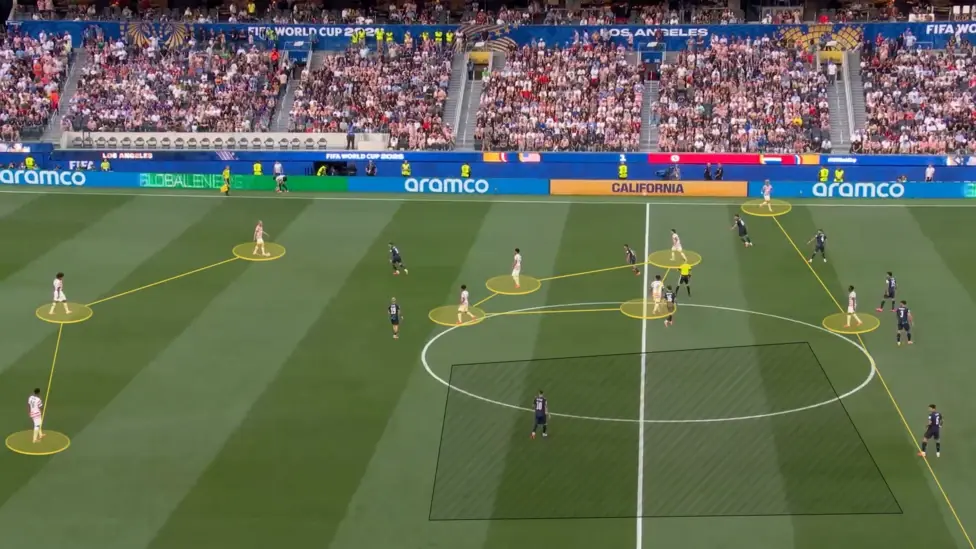
Importantly, Pochettino's interpretation of the system is not rigid. While the team's positional structure often resembles a 3-box-3, players are afforded significant freedom to rotate within it, whether that means a fullback tucking inside, a midfielder dropping deeper to facilitate build-up, or a winger holding width while teammates occupy central spaces. The emphasis is on creating numerical superiorities and exploiting space rather than adhering to fixed positional assignments.
Out of possession, the same principles apply. Rather than retreating into a compact mid-block, the United States pressed aggressively across the pitch, trusting their athleticism and organization to win the ball back in the opposition’s half.
.png)
Possession-adjusted data from the Paraguay match illustrates the approach perfectly: the U.S. ranked second among World Cup nations for final-third pressures, yet 38th out of 40 teams for defensive-third pressures. 78.2% of their pressing actions were directed at opponents rather than passing lanes, reflecting a distinctly man-oriented defensive model. The result is a side that has retained its traditional grit while embracing a far more proactive and modern tactical identity.
The United States' physical output was equally impressive. Across the tournament, they rank among the leading nations for both total distance covered and high-speed runs, a reflection of the relentless work rate and athletic intensity that underpin Pochettino's approach — reminiscent of his infamous high-octane Tottenham side that almost won the Champions League in 2019.
Weston McKennie and Malik Tillman were crucial to this defensive approach. McKennie completed 34 of his 35 pressure attempts against Paraguay, the highest total on the team, while Tillman completed 31 of 34 pressure attempts, the second-highest figure despite often operating from deeper midfield positions. Ahead of them, Folarin Balogun set the tone from the front, completing 27 of 30 pressures as he spearheaded the U.S. press. Together, the trio formed the first line of a relentless defensive effort that repeatedly disrupted Paraguay's attempts to build possession through the thirds.
McKennie was particularly influential in the aggression and timing of the press. The Juventus midfielder recorded 20 first-touch pressures, a remarkable figure that reflects how little time Paraguayan players were afforded on the ball before being confronted. This freedom afforded to McKennie and Tillman to step forward and engage opponents was only possible because of the security provided behind them by Tyler Adams — one of the premier ball-winning defensive midfielders in football. Operating as the anchor of Pochettino's system, Adams won 11 total challenges, the highest figure recorded by any player in his position at the tournament to that point, while also contributing four aerial duel wins, 17 ball recoveries, and nine interceptions — a true destroyer. His defensive coverage allowed the United States to maintain an aggressive shape without sacrificing structural central stability.
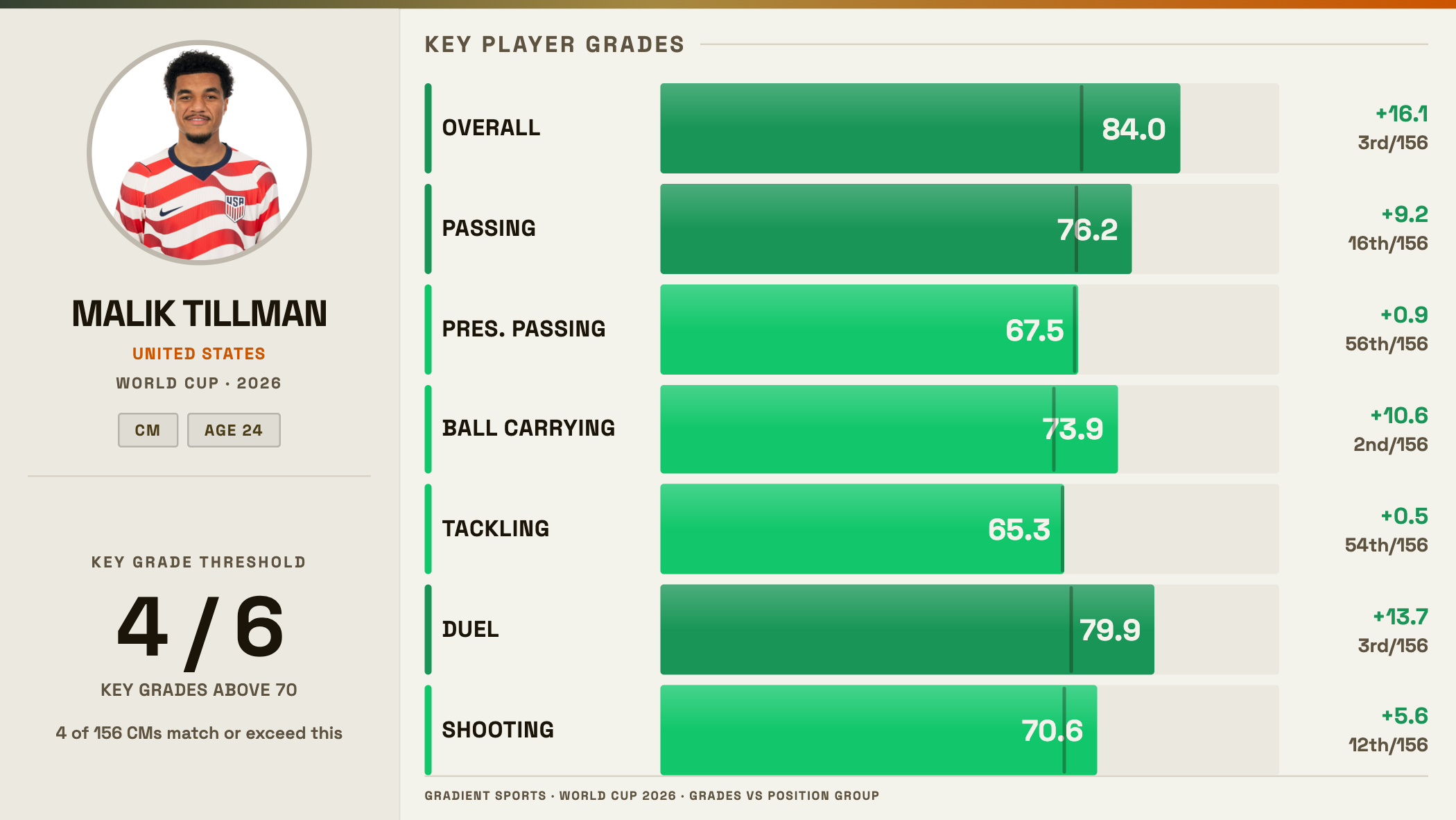
This relentless out-of-possession work didn’t diminish the quality on the ball. Malik Tillman emerged as our third highest graded central midfielder across the opening round of group stage games, finishing with an Overall Grade of 84.0. Against Paraguay, he completed 9 line-breaking passes and received an On-ball Attacking Grade of 87.4 — the highest of any player so far at the tournament. Meanwhile, Folarin Balogun’s Shooting Grade of 87.6 placed him third overall amongst all players, preceded by a certain Argentinian player that needs no introduction.
The U.S. pressed with intensity, but their key players delivered in possession just as effectively. Balogun scored a brace — his second goal assisted by Tillman.
Cape Verde's goalless draw against Spain was one of the biggest surprises of the opening round. Against one of the world's best possession-based sides, Bubista's team adopted an unapologetically defensive approach, spending much of the match in a compact 4-1-4-1 low block designed to deny central space and force Spain into patient circulation around the perimeter. While the result may have appeared unlikely on paper, the underlying data reveals just how disciplined and committed Cape Verde were without the ball.
The scale of Cape Verde's commitment to defending deep is perhaps best illustrated by their phases-of-play profile. Sixty percent of their out-of-possession actions came in their own third, compared to just 2% for Spain in the same match.
In stark contrast to Pochettino’s approach, Cape Verde ranked 40th out of 40 nations for final-third pressures, recording just six per 30 minutes out of possession—a borderline comical stat. Instead of engaging Spain high up the pitch, they retreated into their own defensive structure and waited for opportunities to contest possession closer to goal. Their 257 pressures in the defensive third ranked first in the tournament and more than doubled the tournament average of 115.
.png)
Unlike the United States' man-oriented approach, Cape Verde largely defended space. Their 152 lane pressures ranked third among all nations, while their player pressures ranked just 31st, highlighting a defensive structure focused on denying passing options, rather than aggressively engaging opponents.
That defensive commitment translated into staggering volume. Cape Verde recorded 568 total pressures, the highest figure of any team at the tournament to this point, with 403 of those pressures coming in their own defensive third. By comparison, they applied only nine pressures in the final third, far below the tournament average of 73. The objective was clear: remain compact, deny space between the lines, and challenge Spain to break down an organized block rather than risk opening up the game through aggressive pressing.
The defensive effort required contributions throughout the side. Goalkeeper Vozinha, still performing at the age of 40, was forced into a busy evening after facing 26 shots. His 69.7 Overall Grade currently ranks fifth among goalkeepers at the tournament, while his four claimed crosses lead all goalkeepers. In front of him, centre-back Diney Borges delivered one of the standout defensive performances of the group stage. His 92.4 Clearance Grade ranks fourth among all players.
What makes Cape Verde's performance particularly impressive is the physical profile underpinning it. Despite ranking among the tournament's lowest teams for high-speed running, they covered above the tournament average in total distance. Rather than relying on explosive pressing actions, Cape Verde's players accumulated distance through constant defensive shifting, recovery runs, and collective movement within their block. The result was a quintessential World Cup underdog performance: tactically disciplined, physically demanding, and ultimately rewarded with a hard-earned point against one of the tournament favourites.
.png)
The United States and Cape Verde represent two opposite ends of the defensive spectrum. The U.S. have embraced an aggressive, man-oriented pressing model designed to win the ball high up the pitch and generate attacking opportunities through territorial dominance. Cape Verde, meanwhile, relied on an exceptionally compact low block, prioritizing spatial control and defensive organization over proactive ball-winning.
In context, both approaches made perfect sense. The United States faced a Paraguayan side they believed they could dominate physically and technically, making an aggressive press a logical mechanism for creating chances. Cape Verde, by contrast, were tasked with containing one of the world's premier possession sides, where holding a higher line would have risked exposing space for Spain to exploit. Both managers adapted their defensive structures to the strengths of their opponents.
The more interesting question is what comes next. Will these performances prove to be tactical constants or merely situational responses? As the tournament progresses and the level of opposition changes, it will be fascinating to see whether Pochettino maintains his aggressive man-to-man press against stronger opponents, or whether pragmatism forces a more conservative defensive structure. Likewise, Cape Verde's defensive discipline was instrumental in securing a point against Spain, but against more evenly matched opposition, will Bubista ask his side to defend further from goal and engage more aggressively? The answers may ultimately determine how far both nations can progress in the tournament.