September 23, 2026
Gradient's New Expected Possession Value Model Explained
Announcements


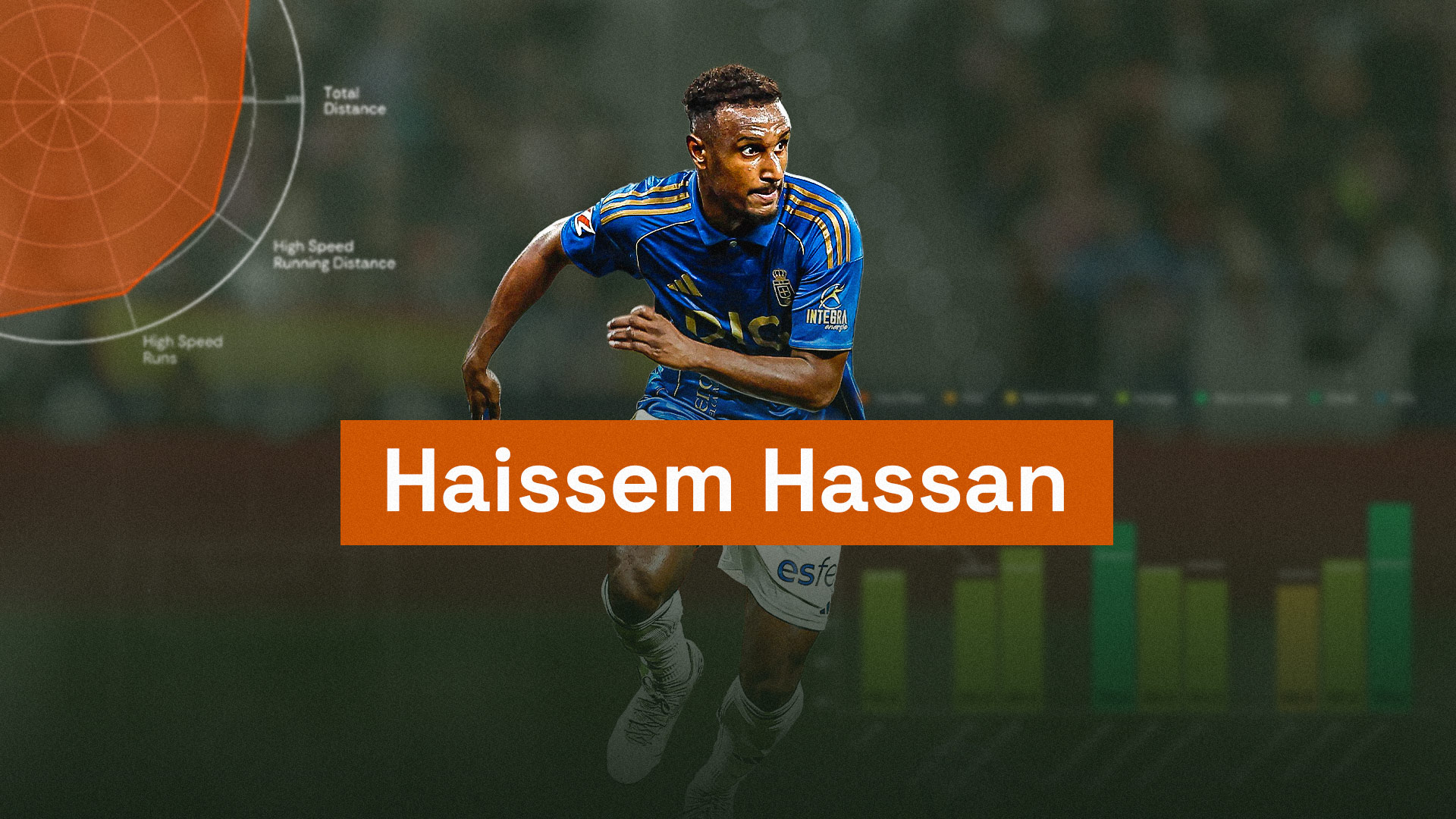
Recently, we introduced our new on-ball acceleration metrics [link], measuring the unique ability to accelerate with the ball quickly. These metrics allow us to identify players who are able to explode past defenders, create separation in tight spaces, and generate dangerous attacking situations that traditional acceleration metrics miss.
.gif)
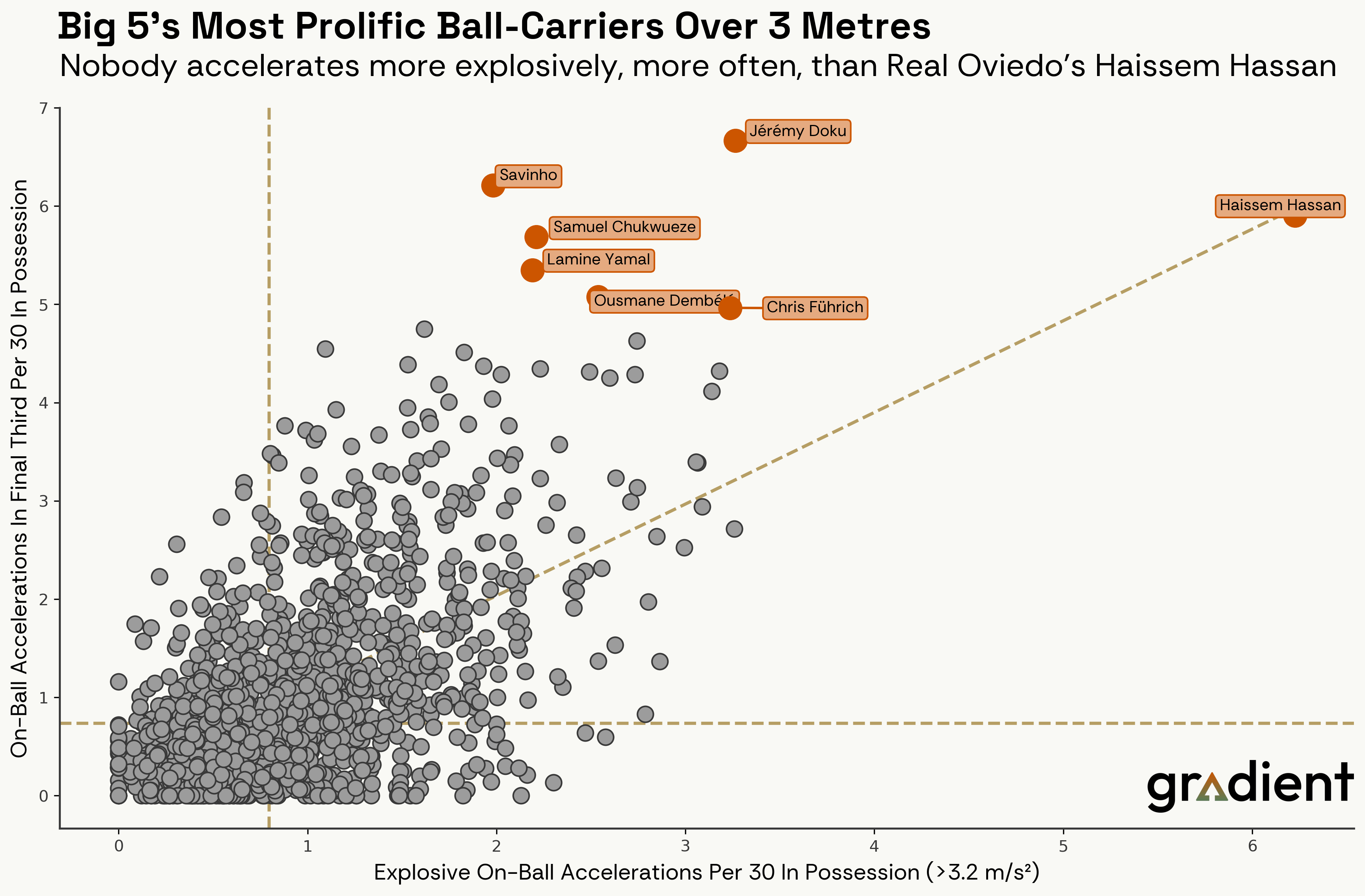
The most dangerous ball-carriers aren't just explosive, they're active in the right places. By plotting explosive acceleration frequency (above 3.2 m/s²) against final third on-ball acceleration volume, we identify some usual suspects who combine explosive ball-carrying ability with attacking intent such as Jérémy Doku, Savinho, Lamine Yamal and Ousmane Dembélé. But one surprising name stands alone: Real Oviedo’s Haissem Hassan. Hassan accelerates explosively with the ball more often than any player in Europe's top five leagues.
So let us dive deeper into his numbers. We divide on-ball attacking into three distinct categories. Dribbling is when a player has the ball and actively tries to beat an opponent. Ball Carrying captures moments when a player has the ball and tries to create space, escape pressure, or move play forward without actively trying to beat an opponent. Tackle Resistance measures a player's ability to retain possession when tackled, again without actively attempting to beat the opponent. Together, these categories provide a comprehensive view of how players manipulate the ball in different competitive contexts.
When it comes to dribbling, four names stand out for both volume and completion rate (per 30 minutes in possession): Lamine Yamal, Nico Williams, Vinicius Junior, and Haissem Hassan. In ball carrying, Hassan separates himself from the pack. A successful ball carry is defined as achieving the intended outcome, whether that's creating space, escaping pressure, or progressing play forward. Tackle resistance tells a different story. La Liga's elite dribblers and ball carriers find themselves in the middle of the pack here, suggesting this metric captures a fundamentally different skill set. One less about agility and more about physical strength and body positioning under direct challenge.
.png)
At Gradient, we believe player evaluation is not one-dimensional. Outcome-driven metrics, such as completed dribbles, successful ball carries, and more sophisticated approaches like xT and EPV, tell us what the (expected) result was of each possession. What they don't tell us is how well a player actually executed. For example, does Hassan execute cleanly while producing all those explosive on-ball accelerations? To answer this, we turn to player grades: our execution-driven assessments that measure the quality of every event. In this analysis, we examine on-ball attacking events including dribbling, ball carrying, and tackle resistance. To understand how we grade (in this instance, passes), visit [link].
Let's examine the ratio of positively graded events versus negatively graded events for Hassan compared to elite wingers in La Liga. A positively graded event indicates the player exceeded expectations in their execution, while a negative grade shows they fell short. These ratios reveal how consistently a player executes well on the ball relative to their mistakes.
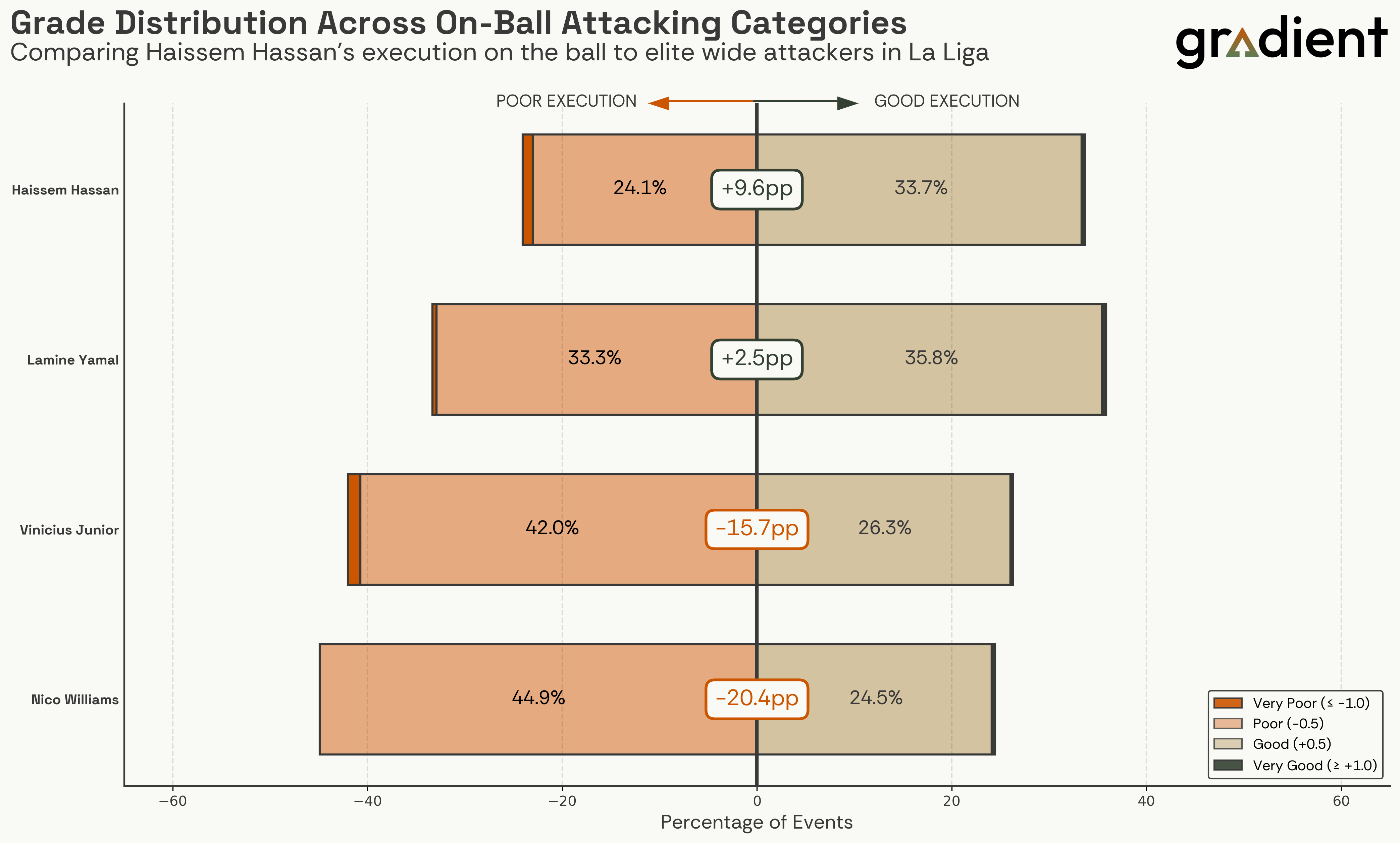
Hassan achieves positive execution in 33.7% of his on-ball attacking events while executing poorly in just 24.1%: a league-leading +9.6pp execution gap among La Liga wingers with at least 50 actions. This elite performance is driven by ranking third in both error avoidance and positive execution rate. Yamal shows a similar but smaller positive tilt at +2.5pp, executing well 35.8% of the time versus below expectation 33.3% of the time. In contrast, Vinicius Junior and Nico Williams both struggle with execution consistency, recording negative gaps of -15.7pp and -20.4pp respectively. Williams executes below expectation in nearly half of his on-ball actions while managing positive execution in only a quarter.
At 24 years old, under contract at Real Oviedo through June 2027, he finds himself at a relegation-threatened club but with a skill set that transcends his current situation. While our analysis examines only how Hassan executes with the ball at his feet (dribbling, carrying, and resisting tackles) and not his passing, shooting, or defensive contributions, it nonetheless reveals something compelling. Hassan combines rare explosive on-ball acceleration with elite execution quality, marking him as a player worth watching. Whether he gets the opportunity to showcase these skills at a higher level may depend on factors beyond his control, but the data tells a clear story: in a league where even celebrated names like Vinicius and Williams struggle with consistency, Hassan's ability to combine explosive speed with elite execution makes him a genuinely unique talent. Whether clubs are paying attention is another question entirely.