September 23, 2026
Gradient's New Expected Possession Value Model Explained
Announcements



When a player collects the ball and explodes towards goal, ball glued to their feet at full sprint, they're demonstrating one of football's rarest and most valuable skills: explosive acceleration with the ball. In a game increasingly defined by tactical organization, the ability to beat your direct opponent with controlled pace makes the difference between breaking down defenses and playing in front of them.
Until now, this skill has been nearly impossible to measure accurately. Most acceleration analysis in football uses a simple threshold: count how many times a player accelerates above 3m/s² for at least half a second. But this approach treats all accelerations as equal: a sprint into space counts the same as a burst with the ball at your feet. You know someone accelerated, just not whether they had the ball while doing it. At Gradient Sports, we combine event data with broadcast tracking to solve this problem. Our frame-by-frame tracking includes possession indicators, allowing us to verify ball control throughout an acceleration effort.
Here's how it works. We identify moments when a player has possession and is moving at walking pace or slower (below 7 km/h, roughly 2 m/s). This ensures we capture true acceleration from near-standstill, like a winger receiving the ball and dribbling past a defender, rather than just speed variations during an existing sprint. From these starting points, we measure acceleration over distances ranging from 3 to 10 meters. At each distance, we calculate the actual acceleration rate in meters per second squared.
%20(1).gif)
Next, we verify the player keeps possession throughout the acceleration. To ensure we measure actual accelerations and ignore tracking data glitches, we apply multiple validation layers:
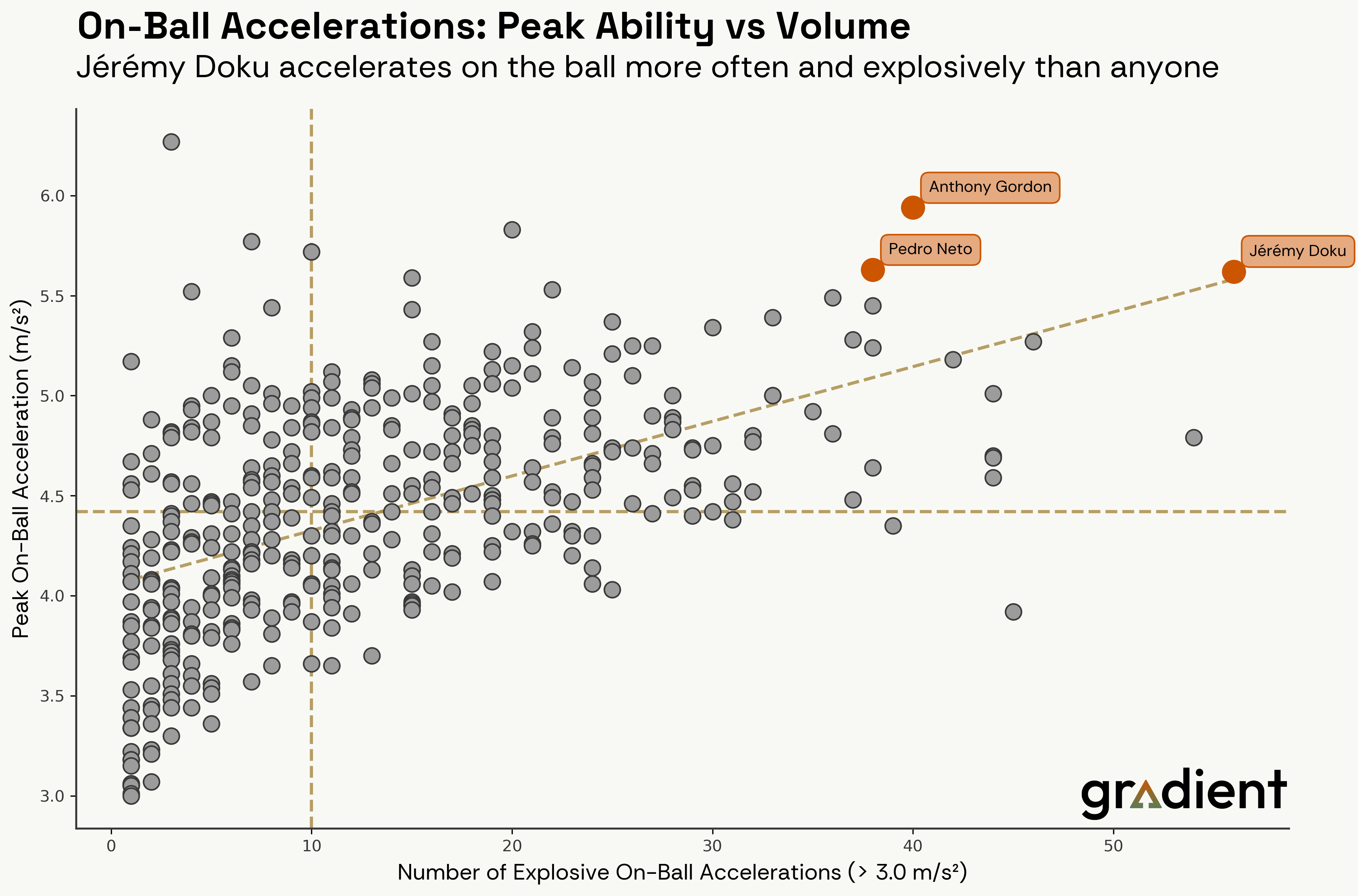
Let's see what this looks like in practice. Through the first 23 Premier League weeks, one name stands above the rest at the 3-meter distance: Jérémy Doku. Among players with more than 10 explosive on-ball accelerations (over 3.0 m/s²), the Manchester City winger leads with 56 explosive efforts across 146 total attempts. His peak of 5.62 m/s² ranks 4th, making him elite in both volume and quality.
Anthony Gordon leads in peak acceleration. The Newcastle United winger has recorded the highest peak at 5.94 m/s² across 86 attempts, with 40 exceeding 3.0 m/s². His 47% explosive rate establishes him as one of the Premier League's most consistently dangerous ball-carriers over short distances. Pedro Neto follows closely behind with a peak of 5.63 m/s² and 38 explosive accelerations across 112 attempts since joining Chelsea.
At the other end of the spectrum, some names stand out for different reasons. Bruno Fernandes reaches 4.01 m/s² as his peak across 84 attempts, while Martín Zubimendi (3.92 m/s², 210 attempts) and Jan Paul van Hecke (3.70 m/s², 255 attempts) show similar numbers. These aren't tracking errors, they're players whose strengths lie elsewhere, built on vision, positioning, and tactical intelligence rather than explosive acceleration with the ball.
Of course, explosive accelerations with the ball don't tell the whole story. Players also need the ability to accelerate without the ball. Therefore, we also measure all accelerations made over distances ranging from 3 to 10 meters, regardless of possession.
When we look at all accelerations, some interesting patterns emerge. Yoane Wissa tops the rankings at 6.18 m/s², yet he doesn't appear in the on-ball top rankings at all. Anthony Gordon proves his all-around explosiveness, ranking 1st with the ball and 9th (5.64 m/s²) without it, showing elite acceleration ability in both contexts.
Perhaps most striking is Bryan Mbeumo's profile. The Manchester United forward ranks 7th when all accelerations are measured (5.68 m/s²), but drops to 171st when accelerating with the ball (4.14 m/s²). This suggests he excels at explosive off the ball runs, but his acceleration drops significantly when controlling the ball.
At Gradient, Physical Metrics have always been a core pillar of how we push football analysis forward, not by measuring more for the sake of it, but by measuring better. From the beginning, our focus has been on capturing the physical actions that truly influence the game and doing so with a level of precision that reflects how football is actually played. The introduction of On-Ball Acceleration Metrics is a direct extension of that commitment to innovation, combining tracking data, advanced modelling, and rigorous validation to quantify a skill that has long been understood intuitively but never accurately measured at scale.
If you're interested in finding out more information about our physical data set, please get in touch, at sales@gradientsports.com.