July 23, 2026
Control, Carry, Create: Three Midfielders Who Defined the 2026 World Cup
Player Grades



The world of football data can often be misleading, as every player, team, and system requires different player profiles to find success. We believe that Gradient Sports player grades, alongside our advanced event data set, can help teams, agencies, and media companies showcase data the right way.
A prime example of this is William Saliba. To many, he is regarded as one of the best centre-backs in world football, yet his traditional defensive metrics in the Premier League this season look... poor.
If a team or media company were to use only traditional data to inform their decision-making, this is what they might say about him:
William Saliba’s 41.3% challenge win percentage ranks last among centre-backs (to play 50% or more minutes) in the Premier League this season, this includes aerial duels, tackles, 50/50 duels, and defending dribbles.
Saliba’s 2.44 block attempts per 30 minutes out of possession ranks last among centre-backs.
Saliba’s 2.27 clearance attempts per 90 minutes ranks 47th out of 49 centre-backs.
.png)
However, not all defenders are the same, and they can be split into many different player roles. Because of the depth of our data set, we are able to identify what makes Saliba so highly regarded, and showcase why defensive volume doesn't necessarily correlate to success.
At Gradient Sports, we collect 14 different metrics relating to ball control for every player in Europe’s top five leagues. These include:
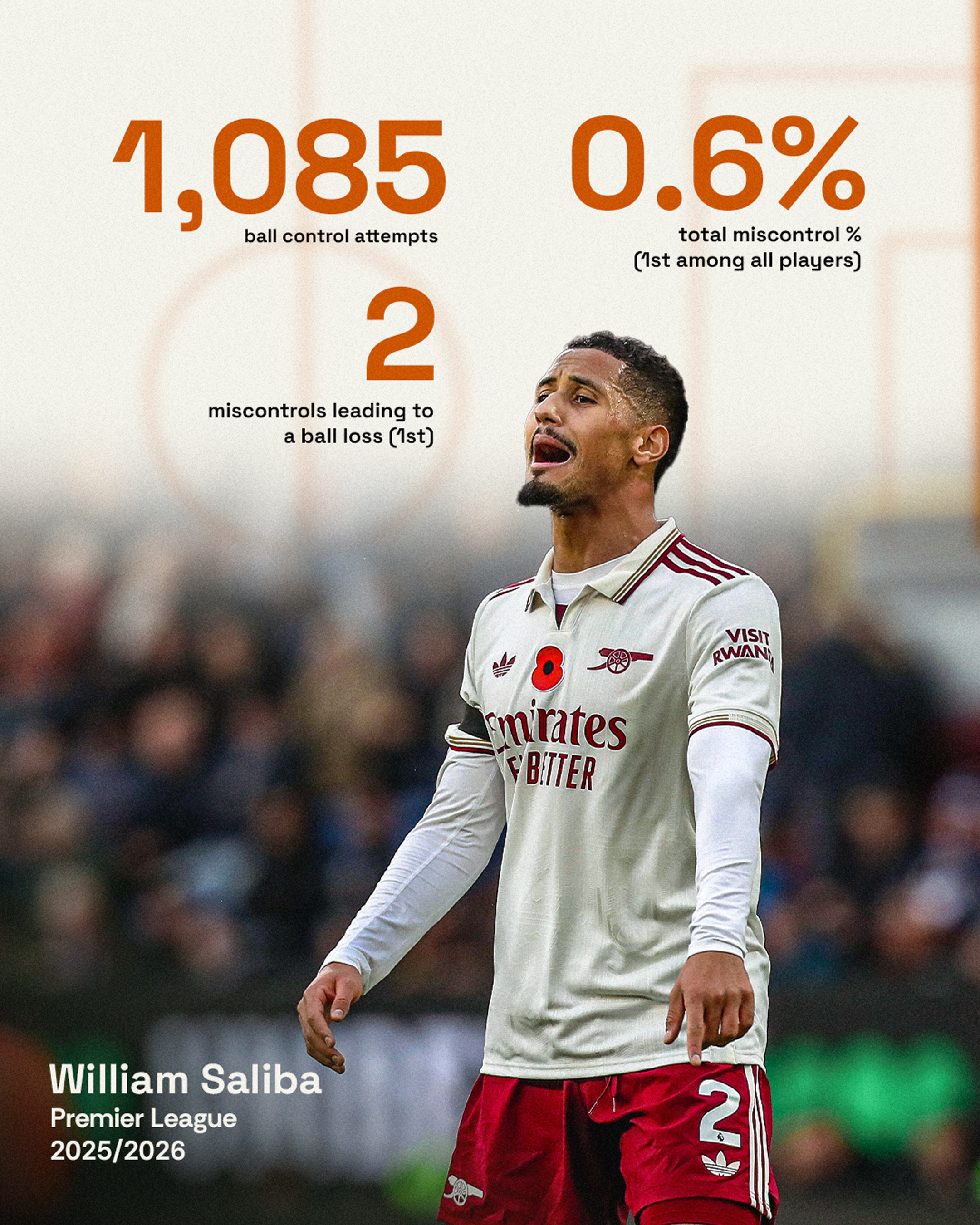
From 1,085 ball control attempts this season, William Saliba has made just one miscontrol under pressure and only two miscontrols leading to a ball loss. His 0.6% total miscontrol percentage ranks first among all outfield players in the Premier League, highlighting his composure.
For reference, the average miscontrol percentage among Premier League centre-backs who have played 50% or more of available minutes this season is 1.82%.
Saliba's skill at receiving the ball and avoiding errors/ ball losses is arguably just as important as traditional defensive metrics, it's just been something hard to quantify past the eye test, until now.
Another area we manually grade is defensive positioning. This grading is used exclusively for defenders and applies to situations involving marking and defensive positioning.
These grades are primarily fault-based, meaning positive grades are generally not available, with one exception. Positioning grades are applied any time a defender is out of position, but one of the most common situations for a possible positioning grade is when a line-breaking pass is played.
Each action is evaluated in context, with grades assigned based on whether a defender’s positioning contributes to opposition progression, prevents advancement, or directly disrupts attacking intent. The system is primarily fault-based, with negative scores reflecting positional lapses of varying impact, while a limited number of positive outcomes are recognised when intelligent positioning actively benefits the defensive unit. (For more information on this, please contact us).
In the Premier League this season, Saliba has made just 0.38 positional mistakes per 30 minutes out of possession. This ranks first among all outfield players and places him well ahead of the centre-back average of 1.27.
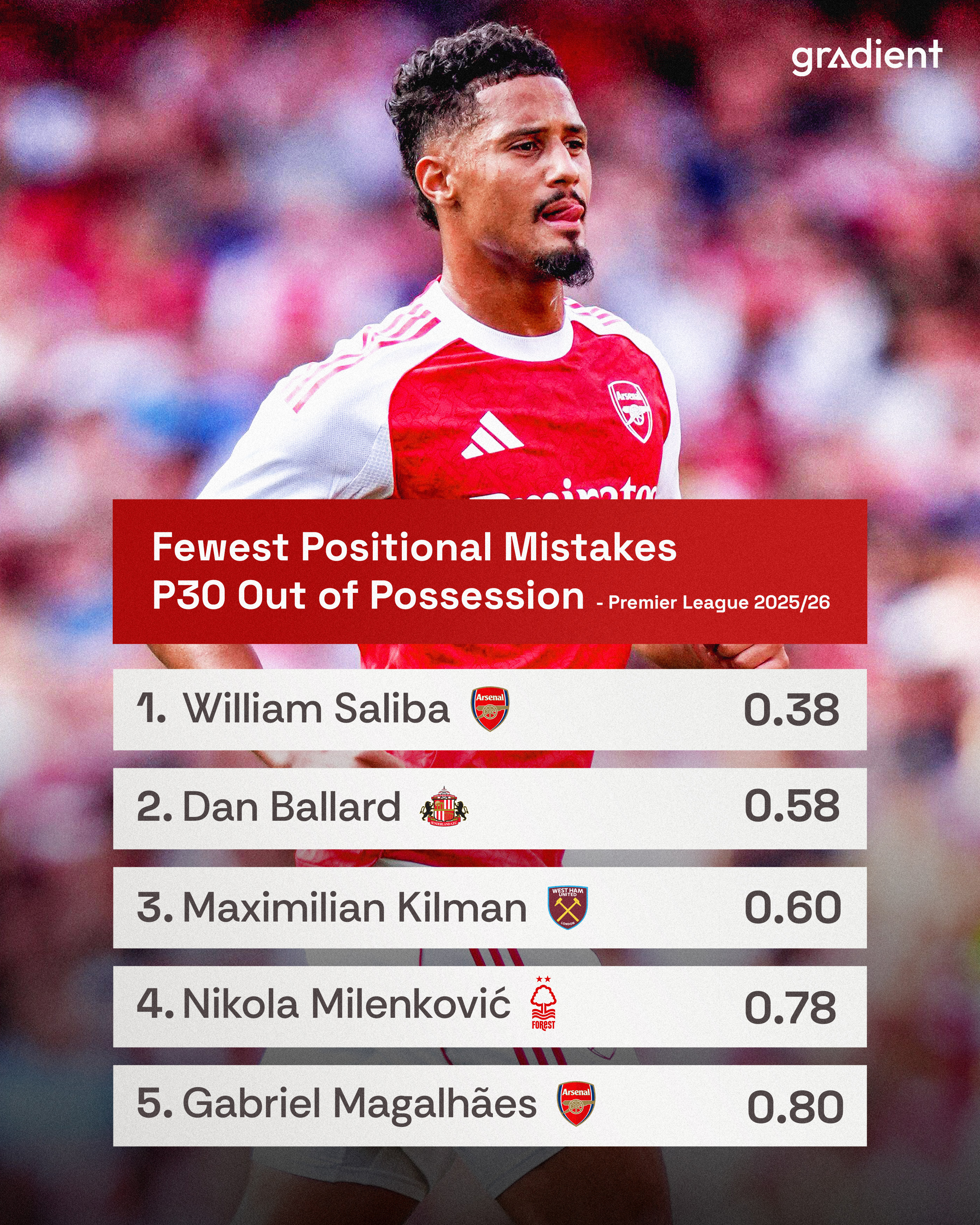
While defensive system influences these underlying numbers, Saliba still ranks far better than Gabriel (0.80), Jurrien Timber (0.90), and Cristian Mosquera (1.64).
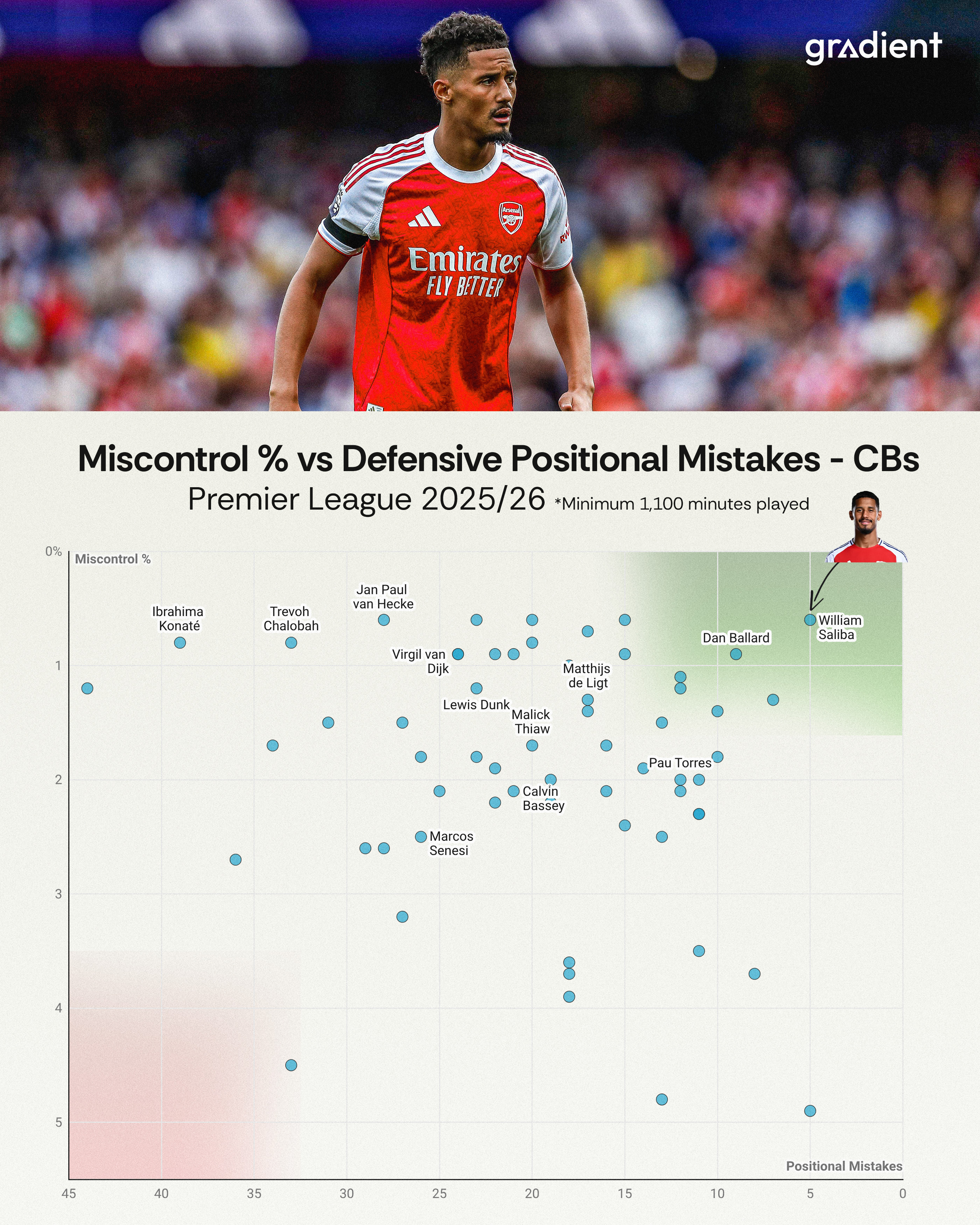
When these two metrics are combined, the profile of Saliba becomes clear and shows how he differs from most Premier League centre-backs. Only Dan Ballard of Sunderland, a former Arsenal academy player, comes close to matching this profile.
Metrics such as challenge win percentage can be useful and serve as a helpful scouting tool for certain player profiles. Especially for teams who play in mid and low blocks. However, they are not always the definitive measure when evaluating centre-back performance.