July 23, 2026
Control, Carry, Create: Three Midfielders Who Defined the 2026 World Cup
Player Grades



As the dust settles on the explosive first legs of the Champions League semi-finals, the narrative has understandably focused on play style and individual brilliance. But beneath the surface, looking at Gradient Sports player tracking data, powered by the Epitome platform, it reveals another factor that could completely dictate the crucial second legs and final: fatigue.
An analysis of domestic league data from the four remaining clubs—Paris Saint-Germain, Arsenal, Atlético Madrid, and Bayern Munich, reveals a striking divergence in how these teams have managed their players. While they are currently fighting through their respective semi-final ties, a look at the physical loads points to a staggering contrast, with PSG and Arsenal representing the absolute extremes.
If PSG and Arsenal survive their semi-finals and meet in the showpiece event, it will be a collision of two entirely different physical profiles.
Here is exactly what the hard data shows heading into the final stretch.
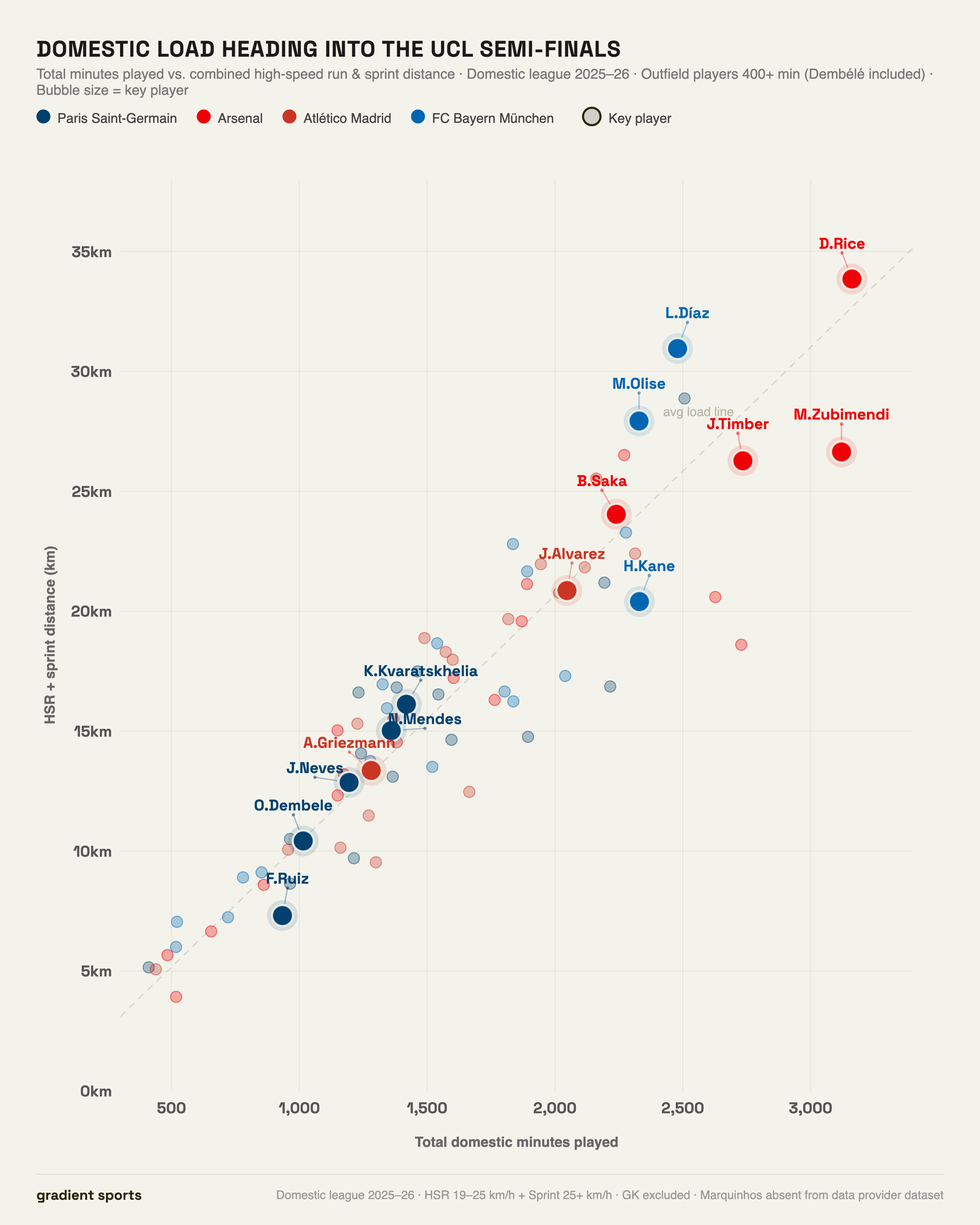
Before looking at the extremes, it is worth contextualising Bayern Munich. The German giants sit somewhere in the middle of the physical load spectrum. Because their domestic season is basically wrapped up, they have been afforded a late-season breather, allowing them to manage minutes in recent weeks.
However, there is a meaningful split within their squad. While the wider group has been rotated more freely, a handful of core players are carrying very heavy cumulative loads from the domestic campaign. Luis Díaz stands out as the most physically burdened Bayern player, with his 30.9 km of combined high-speed and sprint work in 2,480 minutes placing him among the highest-load players across all four teams. Similarly, Harry Kane has amassed 2,331 domestic minutes, indicating he has been run through the season rather than managed through it.
While Bayern sits in the middle and Atlético Madrid's minutes are more evenly distributed , PSG and Arsenal are polar opposites.
Luis Enrique has built a PSG squad perfectly calibrated to absorb rotation. An incredible 70% of PSG's qualified outfield players have played fewer than 1,500 domestic minutes this season. Arsenal sit at the opposite end of the spectrum, with just 42% falling into that bracket. While Mikel Arteta's system demands that a core group cover extraordinary ground every single week, necessity plays an equal role. Arsenal are surviving one of the more punishing Premier League title races in history, meaning they simply haven't been afforded the luxury of resting players.
The starkest contrast is found in the center of the pitch. Rice and Martín Zubimendi represent the spine of Arteta's system, and between them, they have covered more ground and played more minutes than almost anyone else in the data set.
(Note: In the tracking data, an acceleration is defined as the number of times a player's acceleration reaches > 3 m/s²).
.png)
To truly understand this gap, we calculated exactly how much extra football Neves would need to play right now just to match Rice's output this season:
The physical toll on modern wide players and full-backs is extreme, requiring both defensive track-backs and explosive, isolated sprints in the attacking third. Both Bukayo Saka and Jurrien Timber have played a lot of football for Arsenal. Timber alone has logged 2,735.26 minutes and registered 19.19 km of pure high-speed running.
Crucially, both Saka and Timber have recently suffered injuries. This fresh context raises serious, urgent questions about whether Arteta's lack of rotation has finally pushed his key players past their physical limits at the exact wrong time.
By contrast, Ousmane Dembélé and Nuno Mendes have been meticulously managed back from their own injuries domestically:
.png)
To put PSG's extreme load management of their flanks into perspective, football analyst Billy Carpenter notes a staggering reality: Nuno Mendes averages just 8.8 league full-90s a season for PSG. Across five seasons in Paris, he has finished fewer total games than Ben White did in a single year for Leeds. Mendes has logged just 1,359.56 minutes this season. He is hitting peak athletic form precisely when the Champions League demands it.
None of this guarantees PSG a ticket to the final, nor does it guarantee they will win it if they get there. Tactical superiority, individual moments of quality, and the internal dynamics of specific matches will matter far more than aggregate distance figures. Arsenal are in the semi-finals because their intense, high-load system works.
However, there is a well-established pattern in knockout football: the team with fresher legs in the final twenty minutes, when pressing intensity typically drops and decisive moments cluster, tends to have the advantage.
If PSG and Arsenal successfully navigate their respective semi-finals to meet in Budapest, the clash may be defined by this physical chasm.